

 English
 русский
 Español
 中文简体
中文简体
Content
- 1 What Are Cranes Used for in Construction?
- 2 How Cranes Work: The Engineering Behind the Lift
- 3 Types of Cranes for Construction: A Practical Guide
- 4 Tower Crane Erection: How Cranes Are Assembled on Site
- 5 History of Tower Cranes: From Roman Treadwheels to Digital Control
- 6 Tower Crane Disassembly: How the Crane Comes Down
What Are Cranes Used for in Construction?
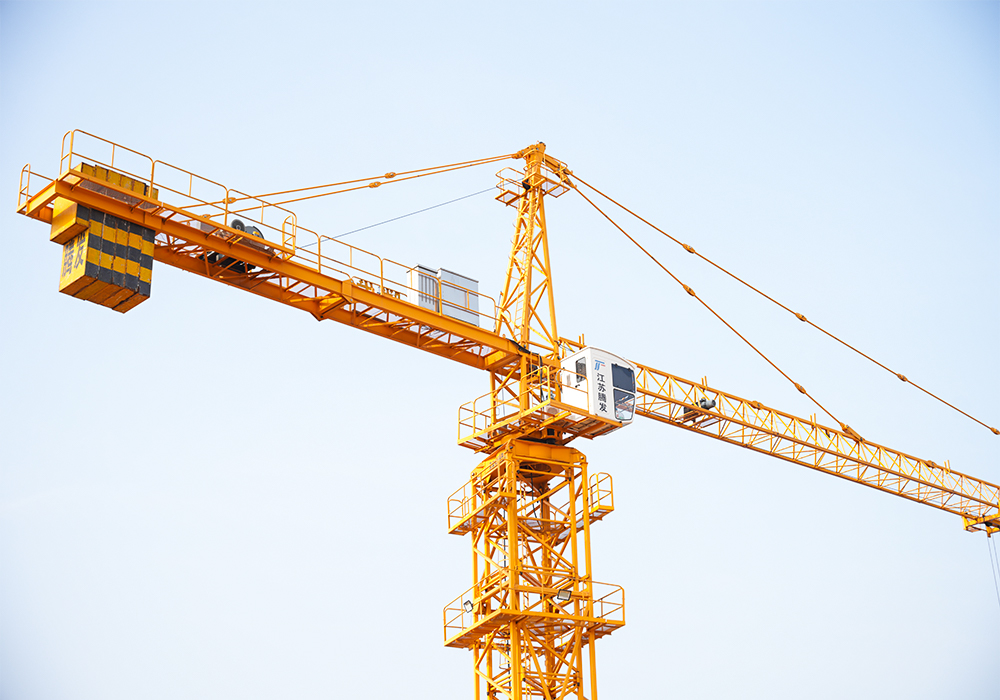
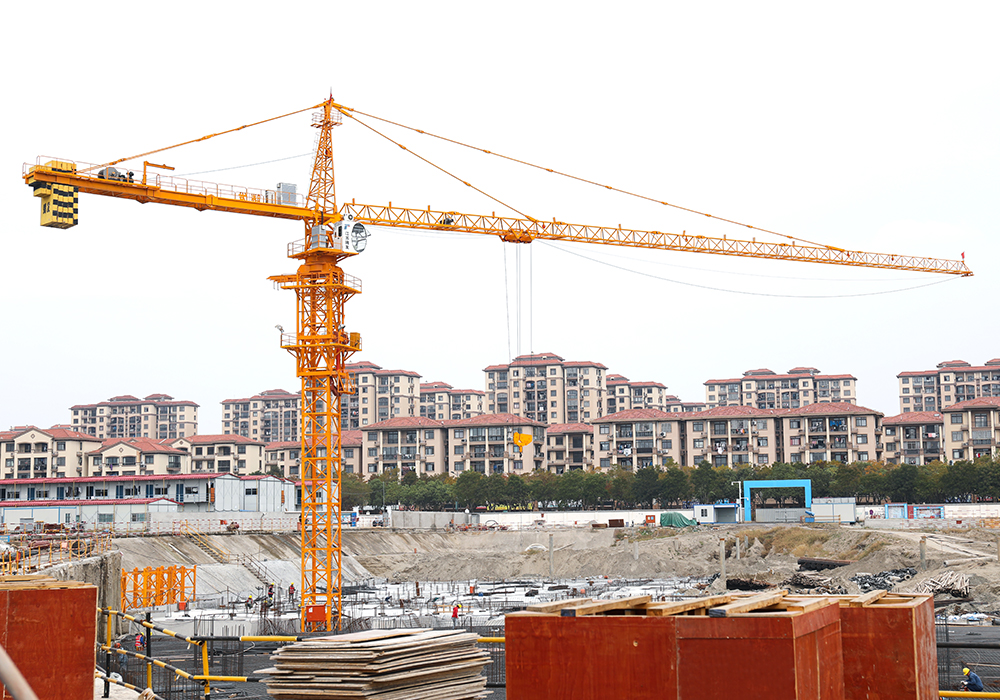
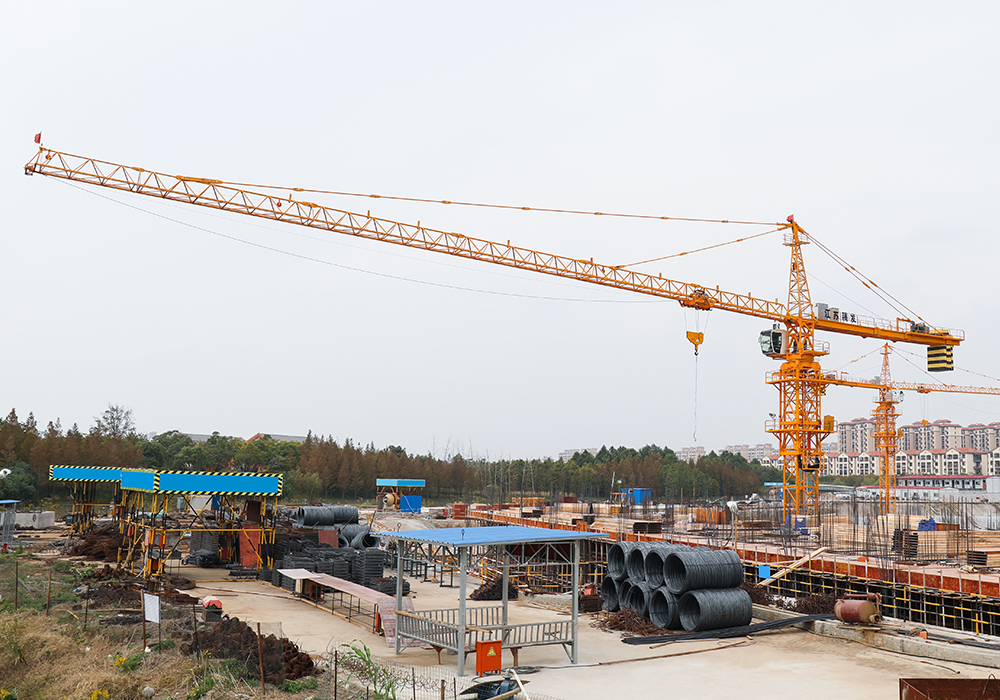
Cranes are the primary means of vertical and horizontal material movement on construction sites. They lift structural steel, precast concrete panels, mechanical plant, formwork, and materials to heights and positions that no other equipment can reach economically. On a high-rise building site, a tower crane is not one of several options for moving loads — it is the operational center of the site, and every other trade works around its lift schedule.
The specific tasks cranes perform in construction include: placing steel beams and columns during structural erection; positioning precast concrete floor slabs, staircases, and facade elements; lifting mechanical and electrical plant (chillers, air handling units, generator sets) to roof or plant levels; relocating formwork and falsework as floor construction advances; and supplying concrete in skips to floors without pump access. On large civil infrastructure projects — bridges, dams, industrial plants — cranes additionally handle heavy single lifts of components that may weigh hundreds or thousands of tonnes.
The productivity of a tower crane is measured in lift cycles per shift. A modern luffing-jib tower crane on a tight urban site might complete 60–100 productive lifts per day, each representing materials that would otherwise require multiple workers and hours to move manually. The cost of crane downtime — typically $1,500–$5,000 per day in hire cost alone, before the knock-on effect on dependent trades — explains why crane planning and scheduling are treated as critical path items in construction programming.
How Cranes Work: The Engineering Behind the Lift
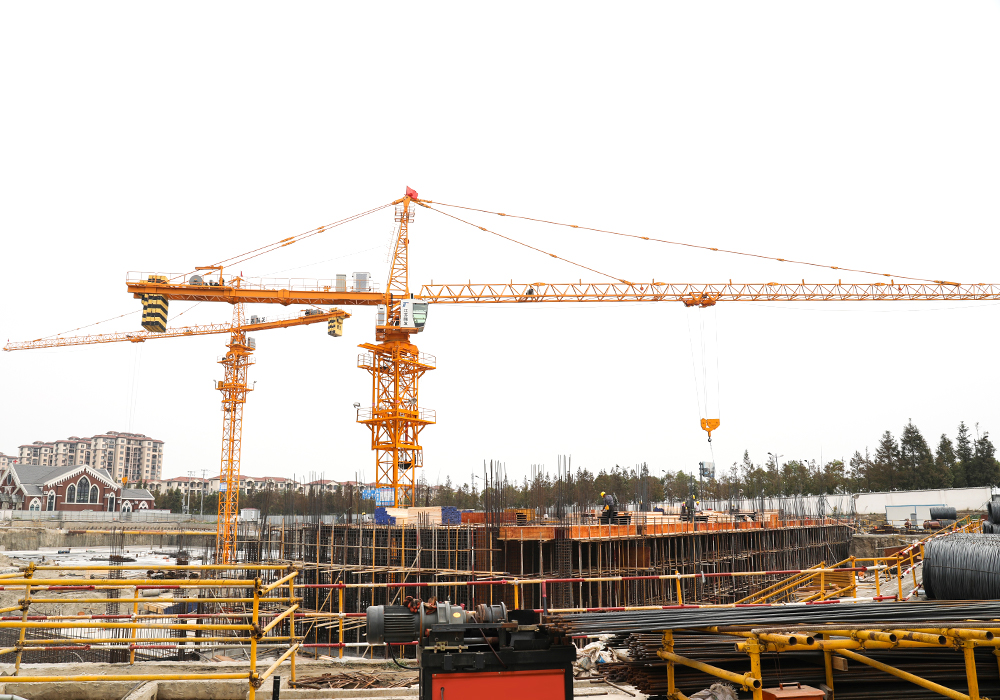
A tower crane works by combining three mechanical systems — the hoist, the trolley (or luffing mechanism), and the slew — to position a load in three-dimensional space above the site. Understanding how each system functions explains both the capability and the limits of the machine.
The Hoist System
The hoist raises and lowers loads using a wire rope drum driven by an electric motor (typically 30–132 kW depending on crane class) through a gearbox. The hoist rope runs over sheaves at the jib head and trolley, and terminates at the hook block. Hoist speed is variable — fast for empty hook travel, slow and precisely controllable when landing loads in confined spaces. Modern cranes use frequency inverter drives that allow infinitely variable speed from 0 to maximum hoist speed, replacing the older stepped-speed contactors that caused rope shock loading and pendulum swing.
The Trolley and Jib
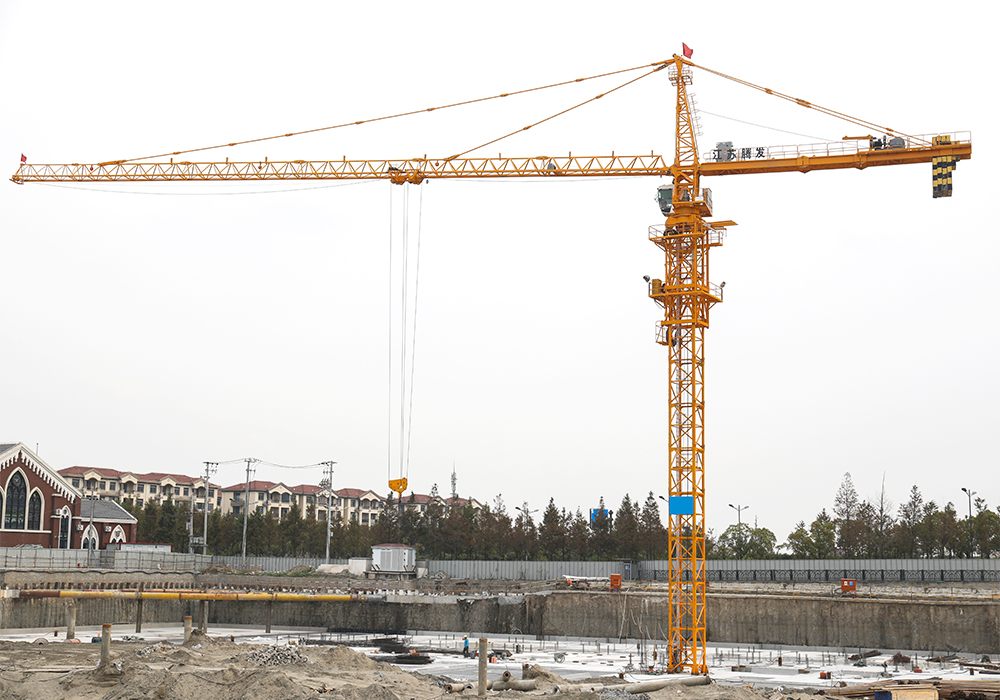
On a flat-top or hammerhead tower crane, the trolley travels along the bottom chord of the horizontal jib under the drive of a trolley motor. Moving the trolley inward or outward changes the working radius without changing the height of the hook — allowing the operator to position a load at any point within the crane's swept area from minimum radius (typically 2–3 m) to maximum radius (the full jib length, commonly 40–80 m on large cranes). The maximum lift capacity at maximum radius is always significantly lower than at minimum radius: a crane rated at 10 tonnes maximum capacity might only lift 2–3 tonnes at full radius, because the moment (force × distance from mast centerline) is the limiting factor, not raw motor power.
The Slew Mechanism
The slew bearing and drive motor rotate the entire upper structure — jib, counterjib, cab, and machinery platform — through 360° around the fixed mast. Slew speed is low (typically 0.5–0.8 rpm) and is the limiting factor in cycle time for lifts that require large angular travel. The ballast on the counterjib (precast concrete blocks, typically 10–30 tonnes depending on crane class) counteracts the moment of the loaded jib and keeps the mast in net compression rather than bending — which is the structural condition the mast sections are designed to carry.
Types of Cranes for Construction: A Practical Guide
Construction uses several distinct crane types, each suited to specific site conditions, load requirements, and project durations. The choice between them is a site logistics decision as much as an engineering one.
Hammerhead (Top-Slewing) Tower Crane
The most common tower crane type in commercial and high-rise construction globally. The horizontal jib and counterjib are mounted on a slewing ring at the top of the mast, giving the characteristic T-shaped profile. Jib lengths typically range from 40 to 80 m, and maximum capacities from 6 to 20 tonnes. Hammerhead cranes require significant clear slewing radius — the entire jib sweeps through 360° — which makes them unsuitable for very tight urban sites where the jib would overhang neighboring buildings or infrastructure.
Luffing-Jib Tower Crane
The luffing-jib crane replaces the horizontal trolley travel with a jib that raises and lowers (luffs) in angle — from near-horizontal to near-vertical — to vary the working radius. Because the jib sweeps upward rather than horizontally, it requires far less horizontal clearance when slewing, making it the standard choice for dense urban sites, basement construction, and projects where multiple cranes must operate in proximity without collision risk. The trade-off is slower radius change (luffing a jib takes longer than trolleying) and higher crane cost.
Self-Erecting Tower Crane
Smaller tower cranes (typically up to 6 tonnes capacity, 30–40 m jib) that can be transported on a standard truck and erected by a small crew without a mobile crane, using built-in hydraulic folding mechanisms. They are used on low-to-mid-rise residential construction, renovation projects, and sites where the cost and logistics of a full tower crane erection are disproportionate to the project scale.
Mobile Crane (All-Terrain and Crawler)
Mobile cranes are not fixed to a foundation and can be repositioned during a project. All-terrain cranes travel on road under their own power; crawler cranes move on tracks and are suited to soft ground conditions and very heavy lifts. Mobile cranes are used for steel erection on low-rise structures, plant lifts, precast concrete installation, and any application where a fixed tower crane cannot be justified. For a single very heavy lift — placing a bridge girder, erecting a cooling tower, installing heavy mechanical plant — a large crawler crane (capacity 500–3,000 tonnes) is often the only practical option.
Derrick Crane and Building Maintenance Unit
Derrick cranes are compact, high-capacity cranes designed to climb the face of a completed building, typically used on supertall structures where a conventional tower crane cannot reach the upper floors economically. Building maintenance units (BMUs) serve a related function on completed buildings for façade access and window cleaning, but are not construction cranes in the primary sense.
| Crane Type | Typical Capacity | Best Application | Key Limitation |
|---|---|---|---|
| Hammerhead tower crane | 6–20 t | Commercial high-rise, open sites | Requires full horizontal slewing clearance |
| Luffing-jib tower crane | 8–25 t | Dense urban sites, multi-crane sites | Slower cycle time, higher cost |
| Self-erecting tower crane | 1–6 t | Low-rise residential, small sites | Limited height and capacity |
| All-terrain mobile crane | 50–1,200 t | Single lifts, steel erection, plant installation | Ground bearing pressure, outrigger space |
| Crawler crane | 100–3,000 t | Very heavy lifts, soft ground | Road transport requires dismantling |
Tower Crane Erection: How Cranes Are Assembled on Site
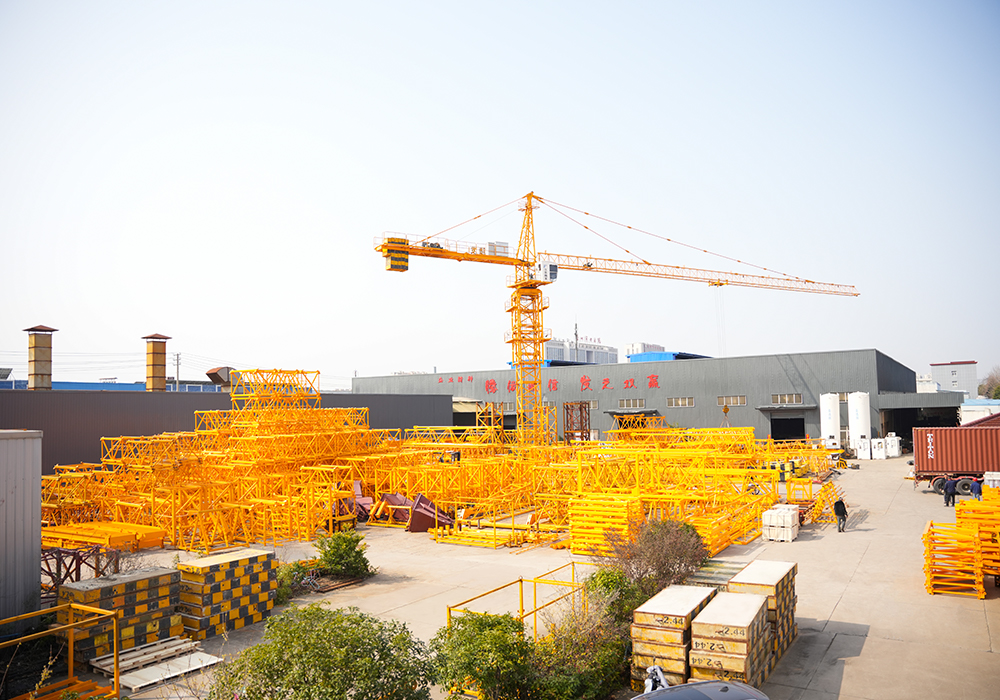
Tower crane erection is one of the most technically demanding operations in construction logistics. A large tower crane arrives on site in 20–40 truckloads of components — mast sections, jib panels, counterjib, machinery platform, slewing assembly, cab, ballast blocks, and foundation anchor bolts — and must be assembled in precise sequence, typically over 1–3 days for a medium-sized crane.
The erection sequence follows a fixed protocol:
- Foundation preparation: A reinforced concrete foundation pad — typically 5×5 m to 8×8 m in plan and 1.5–2.5 m deep — is cast with embedded anchor bolts to the crane manufacturer's specification. The foundation must achieve full design strength before erection begins, requiring typically 28 days' curing.
- Base mast and slewing assembly: A mobile crane lifts the base mast section(s) and bolts them to the foundation anchor assembly. The slewing ring, turntable, and machinery platform are then lifted and assembled on top of the base mast.
- Jib and counterjib assembly: The horizontal jib is assembled in sections on the ground alongside the crane, then lifted as a complete unit by the mobile assist crane and bolted to the slewing assembly. The counterjib is assembled and lifted separately. Ballast blocks are loaded onto the counterjib before the jib is tensioned.
- Reeving and commissioning: The hoist rope is reeved through the jib head sheaves and hook block, all electrical connections are made, limit switches are set, and the crane is proof-loaded under the supervision of the crane manufacturer's representative or a qualified inspector before entering service.
How Do Cranes Get on Top of Skyscrapers? The Climbing Process
The most common question about tower cranes — how do cranes get on top of skyscrapers — has an elegant engineering answer: the crane climbs itself using a hydraulic climbing frame.
All tower cranes above a certain height are designed with a climbing collar — a steel frame that surrounds the mast just below the slewing assembly and is equipped with hydraulic rams. When the building construction reaches a height where the crane needs to be raised, the climbing process proceeds as follows:
- The climbing collar is engaged and the hydraulic rams extend, lifting the entire upper structure (slewing assembly, jib, counterjib, cab, ballast) by one mast section height — typically 3–6 m.
- A new mast section is lifted using the crane's own hoist, swung into the gap created by the climbing collar, and bolted into position by the erection crew working on the mast access platforms.
- The hydraulic rams retract, lowering the upper structure onto the new mast section. The climbing collar disengages and is repositioned for the next climb.
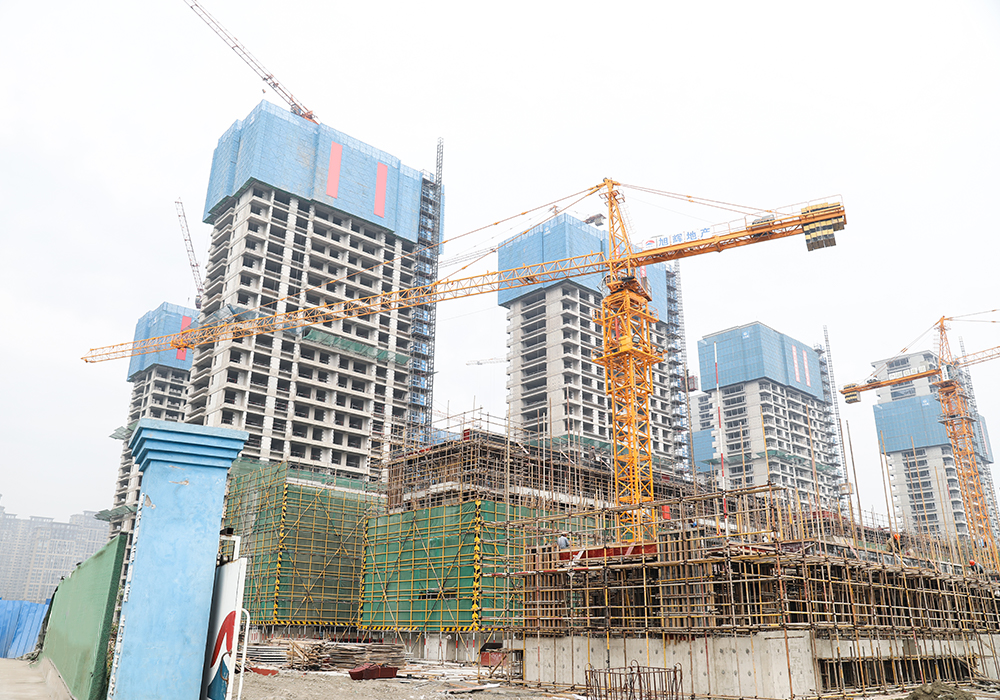
This self-climbing process can be repeated as many times as required as the building rises. Supertall towers — Burj Khalifa, Shanghai Tower, One World Trade Center — required their tower cranes to climb dozens of times during construction. The cranes on the Burj Khalifa (828 m) climbed to heights exceeding 600 m above ground level during the upper floor construction phases.
For very tall buildings, cranes are also tied to the building structure at regular intervals — typically every 30–50 m of free-standing mast height — using mast ties or building anchors: steel frames welded or bolted to the structural frame or core walls that brace the crane mast laterally against wind loads. These ties allow the crane to be far taller than its free-standing capacity would permit, and are designed and certified as structural elements of the temporary works package.
History of Tower Cranes: From Roman Treadwheels to Digital Control
The history of tower cranes is a 2,000-year arc from human-powered timber machines to digitally controlled steel structures capable of lifting 100 tonnes to 800 metres.
The Romans used wooden cranes with treadwheels — large wooden drums walked by slaves or laborers — to lift stone blocks during temple and aqueduct construction. Medieval cathedral builders extended this principle with gin poles and shear-leg derricks to erect stone towers and place carved elements. These machines operated on the same fundamental principles as modern cranes: mechanical advantage through pulley multiplication, and rotational motion converted to vertical lift.
The first recognizably modern tower crane — a fixed-mast machine with a rotating horizontal jib and electric hoist — appeared in Germany in the early 20th century, developed to serve the rapid expansion of industrial and residential construction in the Weimar and post-war periods. Liebherr, founded in 1949 by Hans Liebherr in Kirchdorf an der Iller, Bavaria, played a defining role in the commercialization of the tower crane in Europe with the introduction of the TK 10 in 1949 — a transportable tower crane that could be erected without a separate assist crane, opening the technology to smaller contractors and sites.
The 1960s and 1970s saw rapid development of self-climbing systems, larger capacity classes, and the spread of tower crane use from Europe to construction industries worldwide. The introduction of frequency inverter drive systems in the 1980s and 1990s transformed crane controllability, replacing jerky stepped-speed operation with smooth, variable-speed motion that dramatically reduced load swing and operator fatigue. Anti-collision systems — using radio transponders and programmable limit zones — became standard in the 1990s and 2000s as urban construction projects routinely required multiple cranes operating in overlapping radius zones.
Current-generation tower cranes incorporate load moment indicators with real-time digital display, remote monitoring telemetry that transmits operational data to the hire company and site management, optional remote operation capability, and increasingly, semi-autonomous lift assistance systems that use GPS, laser, and inertial measurement to damp hook swing and assist precision placement. The fundamental engineering has not changed — hoist, trolley, slew — but the precision, safety, and data transparency of the modern machine are orders of magnitude beyond what was possible even 30 years ago.
Tower Crane Disassembly: How the Crane Comes Down
Dismantling a tower crane — the reverse of erection — presents a logistical challenge that is often underestimated in project planning. Once a building is largely enclosed, the crane that served its construction cannot simply be lifted out from above. The crane must descend in reverse of its climbing sequence, removing mast sections from the top until the mast is short enough for a mobile crane to dismantle the jib and upper assembly at ground level.
On a building where the crane has climbed inside the structural core — a common configuration on concrete-core high-rise buildings where the crane sits in the service core void — the final dismantling phase requires the crane to be reduced to components small enough to be lowered by a smaller internal crane or hoist through a purpose-formed opening in the completed floor structure. This opening, called a crane jump hole, is designed into the structural drawings from the outset and is subsequently filled with a concrete infill panel once the crane is removed.
The planning for crane removal begins at the project design stage — not at practical completion. The sequence of tied anchorage removal, temporary works for the jump hole, and mobile crane access at ground level are all scheduled as critical path activities in the project close-out program. On complex urban projects with multiple climbing cranes and tight street access, crane removal planning can be as technically demanding as the initial erection.