

 English
 русский
 Español
 中文简体
中文简体
Content
- 1 Cranes for Construction: The Complete Guide
- 2 History of Tower Cranes: From Ancient Winches to Modern Giants
- 3 Types of Cranes for Construction
- 4 Parts of a Construction Crane
- 5 How Do Cranes Work
- 6 Tower Crane Erection: How Are Cranes Erected
- 7 Height of a Crane and How Much Does a Crane Weigh
- 8 How Do Crane Operators Get to the Top
- 9 Tower Crane Manufacturers: Who Makes the World's Construction Cranes
- 10 High Rise Crane Planning: Crane on Construction Site Considerations
- 11 Frequently Asked Questions About Construction Cranes
Cranes for Construction: The Complete Guide
Construction cranes are the backbone of modern vertical building. From mid-rise office blocks to supertall skyscrapers, no other piece of equipment can match a tower crane's combination of reach, lifting capacity, and operational height. This guide covers everything from the history and invention of the crane to how operators get to the top, how cranes are powered, and how to choose the right type for a given project.
History of Tower Cranes: From Ancient Winches to Modern Giants
The history of tower cranes stretches back further than most people realise. The ancient Greeks developed the first true mechanical crane — the trispastos — around 515 BC, using a simple rope-and-pulley system powered by human or animal effort. These early devices could lift loads of roughly 150 kg, enough to position the dressed stone blocks used in temple construction.
Roman engineers expanded on this concept with the polyspaston, a compound-pulley crane capable of lifting up to 3,000 kg — a figure that would not be exceeded by any portable lifting machine until the Industrial Revolution. The treadwheel crane, common in medieval Europe from the 12th century onward, introduced human-powered rotation via a large wooden wheel, enabling the construction of Gothic cathedrals with walls soaring above 30 metres.
The question of who invented the crane in its modern form is generally answered with two names. Scottish engineer William Fairbairn designed the first steam-powered travelling crane in the 1840s, transforming shipyard and warehouse operations. However, the tower crane as it is recognised today — a slewing jib mounted atop a vertical mast — was pioneered by German engineer Hans Liebherr, who built the first commercial tower crane in 1949 in the post-war German reconstruction effort. His company, Liebherr, remains one of the world's largest tower crane manufacturers to this day.
Types of Cranes for Construction
Not all construction cranes are tower cranes. The correct crane type depends on the project scope, site constraints, required lift height, and load capacity. The main types of cranes used on construction sites include:
Hammerhead Tower Crane
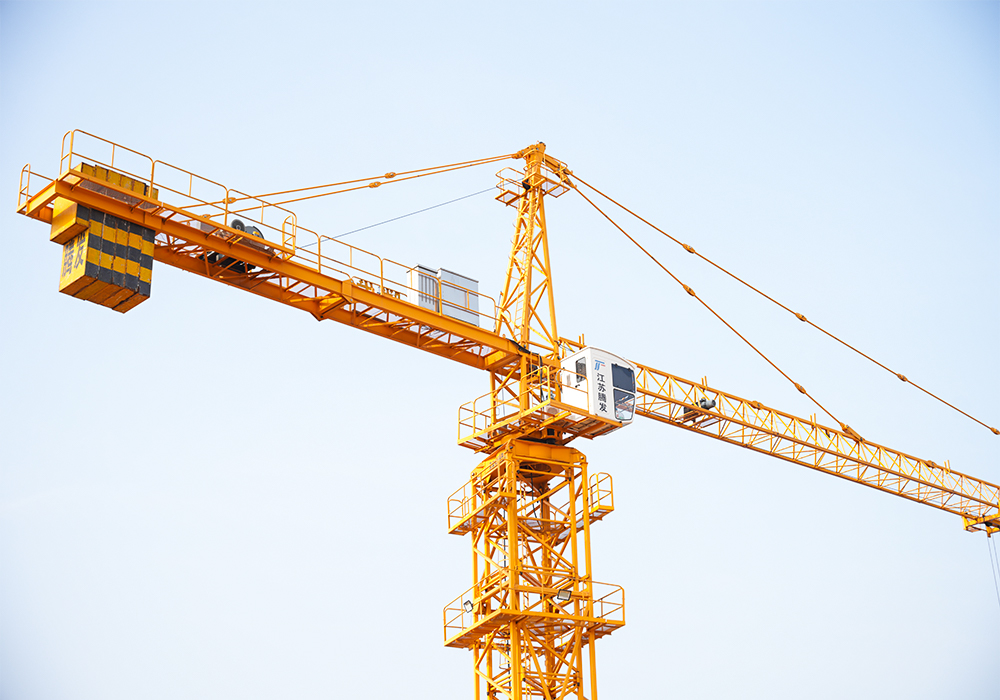
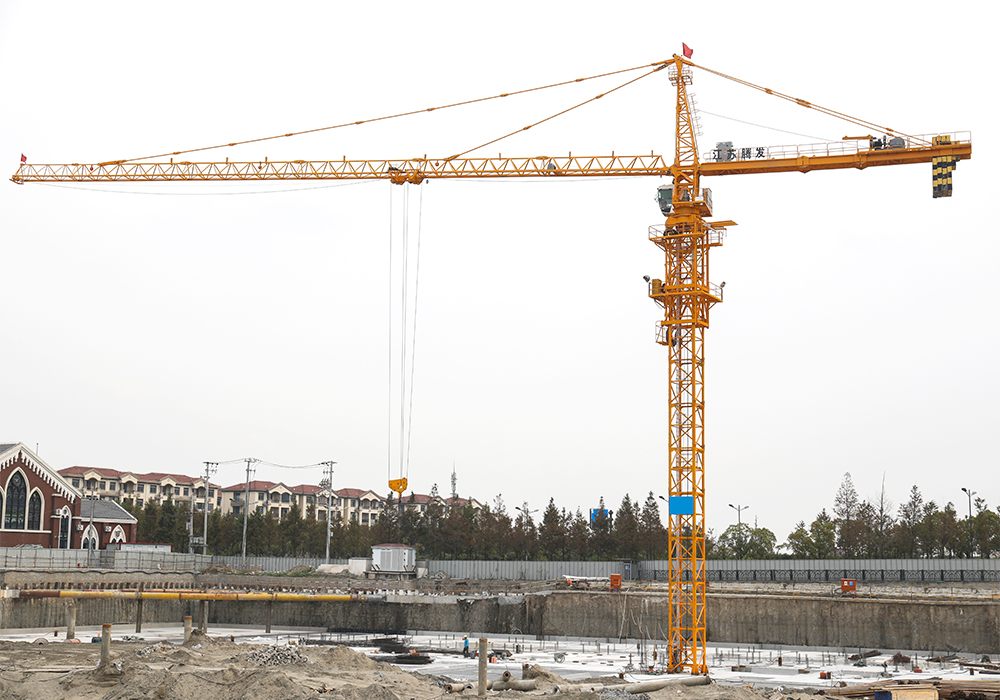
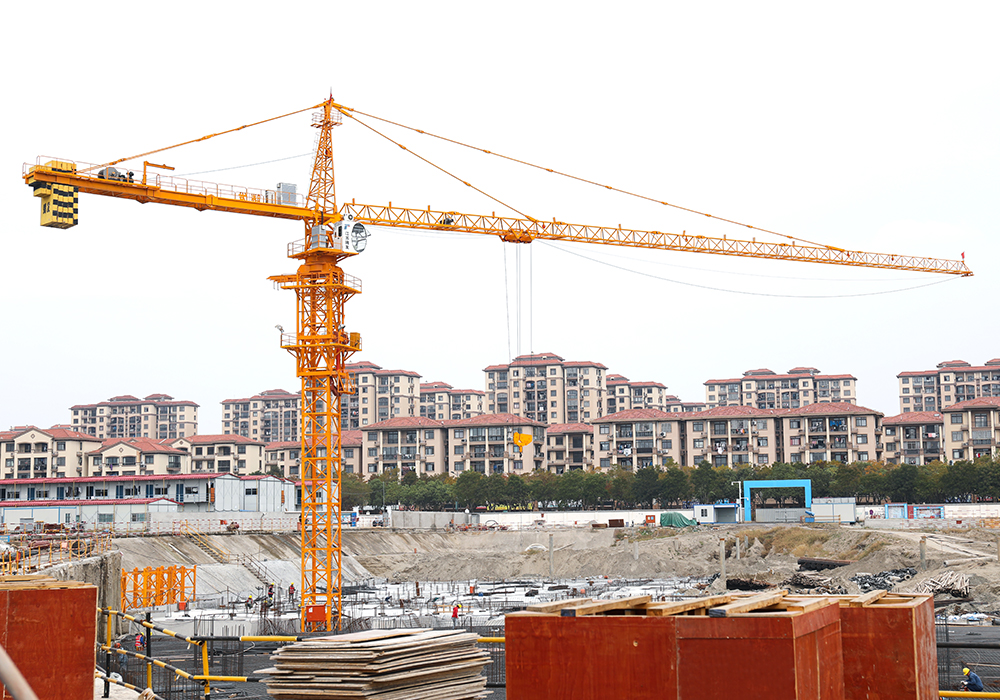
The hammerhead tower crane — also called the top-slewing or saddle-jib crane — is the most widely recognised form. It features a horizontal jib and a counter-jib of roughly equal length extending from a central slewing ring at the top of the mast, giving it the characteristic T-shape visible on urban skylines worldwide. The trolley travels along the jib to position loads at variable radii up to the jib's maximum reach, which can exceed 80 metres on large models. Hammerhead cranes are favoured for high-rise construction because of their predictable load chart and straightforward operation in cluttered airspace.
Flat Top Tower Crane
The flat top tower crane (also luffing flat-top or self-erecting flat-top, depending on the variant) eliminates the traditional A-frame or apex above the slewing ring. The result is a lower overall profile, which significantly reduces the minimum separation required between adjacent cranes on a tight site — the primary reason flat top designs dominate in city centre projects where multiple tower cranes must operate in close proximity. Assembly and disassembly is also faster due to the absence of the top-frame structure.
Rail Mounted Tower Crane
A rail mounted tower crane travels along a fixed track laid at ground level, combining the vertical reach of a tower crane with horizontal mobility across the full length of a structure. This configuration is particularly effective on shipbuilding yards, precast concrete facilities, and linear construction projects such as viaducts or long industrial buildings. The rail gauge, track bearing capacity, and travel speed must be engineered as part of the site plan.
Luffing Jib Tower Crane
Where site boundaries or airspace restrictions prevent the horizontal jib from swinging freely, a luffing jib crane raises and lowers its jib through an arc rather than using a travelling trolley. This dramatically reduces the slewing radius required and allows safe operation beside boundary walls, other cranes, or protected airspace corridors — a common requirement on constrained city-centre sites.
Mobile Crane and Crawler Crane
Beyond tower cranes, mobile telescopic cranes (truck-mounted) and crawler cranes (tracked undercarriages) handle lifts that require repositioning between picks or that fall outside the tower crane's envelope. Mobile cranes are indispensable during tower crane erection itself, lifting mast sections and structural components into position before the self-climbing mechanism takes over.
| Crane Type | Best Application | Key Advantage | Typical Max Capacity |
|---|---|---|---|
| Hammerhead Tower Crane | High-rise construction | Long reach, large capacity | 25–64 t (tip: 3–6 t) |
| Flat Top Tower Crane | Congested urban sites | Low profile, crane proximity | 6–16 t |
| Luffing Jib Tower Crane | Restricted airspace sites | Minimal swing radius | 6–32 t |
| Rail Mounted Tower Crane | Linear structures, yards | Horizontal travel coverage | Up to 100 t (yard cranes) |
| Mobile/Crawler Crane | One-off heavy lifts, erection | Full mobility, rapid setup | Up to 3,500 t (crawler) |
Parts of a Construction Crane
Understanding the key components of a tower crane clarifies how it functions and how each element contributes to safe, efficient lifting.
- Mast (tower): The vertical steel lattice structure that gives the crane its height. Standard mast sections are typically 3–6 metres tall and bolted or pinned together during erection. The mast transfers all loads — including wind — to the foundation.
- Slewing unit: Mounted at the top of the mast, this motorised ring bearing allows the entire upper structure to rotate through 360°. The slewing motor and gear typically deliver a rotation speed of 0.6–0.8 rpm.
- Jib (boom of a crane): The horizontal working arm that extends outward from the slewing unit. The boom of a crane carries the trolley and hoist rope. Jib lengths commonly range from 40 to 80 metres depending on the model.
- Counter-jib: The shorter rear arm that carries the counterweights — typically heavy concrete or steel blocks — to balance the load on the working jib. Counterweight masses range from a few tonnes on small cranes to over 20 tonnes on large hammerhead models.
- Trolley: Travels horizontally along the jib to change the load radius (distance from mast centre to the hook). Trolley speed typically ranges from 20 to 80 m/min on modern cranes.
- Hook block and hoist rope: The hook hangs from a steel wire rope wound onto the hoist drum. The hoist motor raises and lowers the load; hoist speeds commonly reach 60–120 m/min at single-line pull.
- Tower crane cab: The enclosed operator cabin, positioned at the top of the mast just below or alongside the slewing unit. The tower crane cab contains all operating controls, load monitoring displays, anemometer readouts, and communication equipment. Most modern cabs offer climate control and ergonomic seating to reduce operator fatigue during shifts that regularly exceed 8 hours.
- Climbing frame (hydraulic climbing cage): The mechanism that allows the crane to grow with the building. A hydraulic ram pushes the upper crane structure upward by one mast section height, after which a new mast section is inserted below. This process — called "jumping" — can be completed in 2–4 hours by an experienced crew.
- Foundation anchor: The crane's base — either a concrete ballast cruciform or a cast-in foundation bolt cage anchored into the site's structural slab or a dedicated pad. Foundation design must account for the maximum overturning moment at full jib load and in maximum design wind conditions.
How Do Cranes Work
A tower crane works by combining three simultaneous movements — hoisting (raising the load vertically), slewing (rotating the jib horizontally), and trolleying (moving the load radially along the jib) — to position a load anywhere within its operating envelope with millimetre precision.
The physics underlying crane operation is moment balancing. The rated load capacity at any given radius is determined by the maximum allowable bending moment at the slewing ring — meaning a crane with a 6-tonne tip capacity at 60 metres radius may lift significantly more weight closer to the mast. This is expressed in the crane's load chart, which operators must consult before every pick.
Modern tower cranes are equipped with load moment limiters (LML) and anti-two-block devices that prevent the operator from accidentally exceeding the crane's rated capacity or driving the hook block into the jib structure. Variable frequency drives (VFD) on hoist and slew motors deliver smooth acceleration and deceleration, reducing load swing and improving cycle times.
How are cranes powered? Virtually all tower cranes in use today are electrically powered via a trailing cable or permanent connection to the site's distribution board. A medium-sized hammerhead crane typically requires a 50–100 kVA three-phase supply. Electric drive systems are preferred over hydraulic or diesel alternatives for tower crane applications because of their energy efficiency, precise speed control, and suitability for regenerative braking — where energy from lowering loads is fed back into the grid.
Tower Crane Erection: How Are Cranes Erected
Tower crane erection is a precisely sequenced operation that typically takes 1–3 days for a standard freestanding crane, depending on the model and site conditions. Understanding the process clarifies why erection planning is as important as any other phase of the project programme.
- Foundation preparation: A concrete anchor block — typically reinforced with anchor bolts or a pre-engineered bolt cage specified by the crane manufacturer — is cast into the ground or into the building's structural slab weeks in advance to allow adequate curing.
- Mast base assembly: The first mast sections are lowered onto the foundation bolts and plumbed precisely vertical using a spirit level or digital inclinometer. Deviation tolerance is typically less than 1 mm per metre of mast height.
- Climbing frame installation: The hydraulic climbing cage is fitted around the mast at the base of the upper structure, ready to lift each new section into position.
- Slewing unit, cab, and jib assembly: A mobile crane lifts the slewing ring, operator cab, counter-jib (with counterweights already fitted), and then the jib sections into position. The jib is assembled on the ground and lifted as a single unit or in sections depending on its length.
- Reeving and commissioning: The hoist rope is threaded through the trolley and hook block, all electrical connections are made, and the crane undergoes function testing, load testing, and safety system verification before the handover certificate is issued.
As the building rises, the crane grows with it through the self-climbing (jumping) process: the hydraulic ram extends, the upper structure is held on climbing pins while a new mast section is slid into position below, and the crane is lowered onto the new section. This cycle repeats every few floors, typically whenever the building structure overtakes the crane's free-standing hook height.
Height of a Crane and How Much Does a Crane Weigh
The height of a crane on a construction site is not fixed — it grows as the project progresses. A typical freestanding tower crane can stand between 50 and 80 metres without tie-in to the structure. When anchored to the building at regular intervals (usually every 20–30 metres of mast), the crane can extend to several hundred metres. The tallest tower cranes ever used in construction reached free-standing heights above 100 metres, with hook heights on tied-in cranes exceeding 300 metres on supertall skyscraper projects.
The weight of a tower crane varies significantly with size and type. A compact self-erecting crane may weigh as little as 3–5 tonnes, while a large hammerhead crane can weigh over 200 tonnes when all mast sections, counterweights, and jib components are included. The Liebherr EC-B series and Potain MDT series — both common tower crane manufacturer offerings at the medium end of the market — typically weigh between 40 and 120 tonnes in site configuration.
How Do Crane Operators Get to the Top
Accessing the tower crane cab is one of the less-discussed but very real aspects of crane operation. How do crane operators get to the top? In almost all tower cranes, access is via a fixed vertical ladder running inside or alongside the mast, with rest platforms at regular intervals — typically every 6 metres, corresponding to mast section joints. On tall cranes, operators may climb 150–250 rungs or more at the start of each shift.
Some modern tower cranes, particularly on very tall structures or in markets with strong labour welfare standards, are fitted with a mast-climbing personnel hoist — a small enclosed car that travels up the exterior of the mast, eliminating the physical demands of ladder climbing. However, this adds cost and requires additional maintenance, so many sites — especially in developing markets — continue to rely on ladder access.
Operators typically spend an entire shift — commonly 8–10 hours — in the cab without descending. Meals, water, and in some cases sanitation facilities are either brought up at the start of the shift or supplied via the hoist rope in a bucket. Fatigue management is therefore a core part of responsible crane operation planning.
Tower Crane Manufacturers: Who Makes the World's Construction Cranes
The global market for tower cranes is served by a relatively small number of dominant manufacturers, though the competitive landscape has expanded significantly with the growth of Chinese production.
- Liebherr (Germany): Considered the founding name in modern tower cranes, producing a full range from self-erecting models to heavy-duty hammerhead cranes with tip capacities up to 64 tonnes.
- Manitowoc / Potain (France/USA): Potain is the world's largest tower crane brand by installed base, offering the widely used MDT flat top and MCT luffing ranges across all major global markets.
- Terex Comedil (Italy): Specialises in flat top and luffing jib cranes, particularly popular in the European and Australian markets.
- Wolffkran (Germany): Known for heavy-duty hammerhead cranes and specialised high-capacity models for industrial and infrastructure applications.
- XCMG, Zoomlion, SANY (China): China-based manufacturers have rapidly expanded their global crane presence, offering competitive pricing across all crane categories and now accounting for a significant share of new crane deliveries in Asia, the Middle East, and Africa.
When selecting a tower crane manufacturer, procurement teams should evaluate not only the unit price but also local parts availability, service network coverage, lead time for mast sections, and resale value — all of which can substantially affect total cost of ownership over a multi-year project.
High Rise Crane Planning: Crane on Construction Site Considerations
Positioning a crane on a construction site — particularly for a high rise crane application — requires engineering analysis well before ground is broken. The key planning variables include:
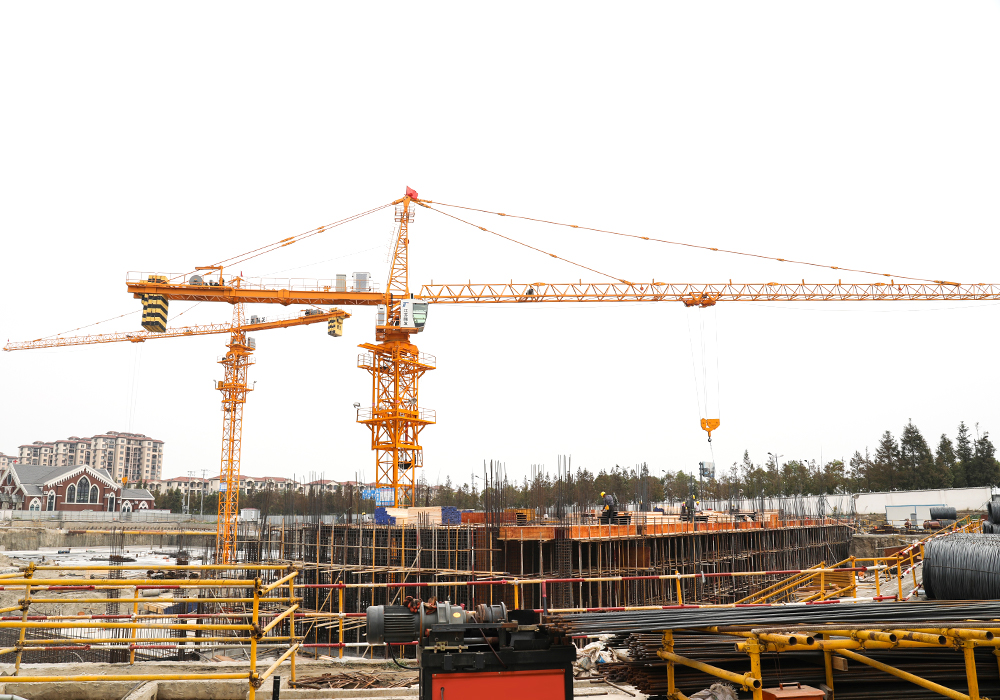
- Coverage analysis: The crane's jib must reach every point of the building footprint plus key laydown areas. For large or irregularly shaped buildings, multiple cranes may be required, demanding careful airspace coordination to prevent jib collision.
- Structural integration: For tied-in cranes on high rise structures, the tie-in frames must be designed into the building's structural drawings at the appropriate floor levels. Each tie transfers horizontal loads of several hundred kilonewtons into the building frame.
- Internal climbing vs. external: On supertall buildings, cranes are often "jumped" inside the building's core shaft — the crane sits within the lift core and climbs using the core walls as anchor points. This protects the crane from extreme wind loads at height and avoids the need for external tie brackets on the building facade.
- Disassembly planning: On tall buildings, the crane cannot simply be dismantled in reverse. A smaller "rescue crane" or a crane climbing out on the roof structure is often required — a process that must be planned from the outset.
- Wind speed limits: Tower cranes have defined maximum operating wind speeds — commonly 72 km/h (20 m/s) — and out-of-service wind ratings that define when the crane must be left in free-slew mode so the jib weathers into the wind. At significant heights, wind speeds are consistently higher than at ground level, making anemometer data a critical operational input.
Frequently Asked Questions About Construction Cranes
- What is the difference between a hammerhead and a flat top tower crane?
A hammerhead crane has a structural A-frame or apex above the slewing ring from which pendant ropes support the jib. A flat top crane has no such apex — the jib is supported by an internal chord structure — giving it a lower overall profile. Flat top cranes are preferred where multiple cranes must work in close proximity because their jibs can pass over each other at lower height differentials.
- How tall can a tower crane go?
Freestanding, a tower crane is typically limited to 50–80 metres depending on the model and foundation design. When anchored to the building structure at regular intervals, there is no practical upper limit dictated by the crane itself — cranes on supertall projects have operated at hook heights exceeding 600 metres above ground.
- How are cranes powered on a construction site?
Tower cranes are almost universally electrically powered, connected to the site distribution board via a trailing cable that grows as the crane climbs. Electrical supply requirements range from approximately 30 kVA for small self-erecting models to over 200 kVA for large hammerhead cranes with high-speed hoists.
- How long does it take to erect a tower crane?
A standard freestanding tower crane can be erected in 1–3 days by an experienced crew using a mobile crane, assuming the foundation anchor is already in place. Self-erecting models with folding jibs can be set up in as little as 20–30 minutes once on site. Disassembly takes a similar amount of time to erection.
- Who invented the modern tower crane?
Hans Liebherr is credited with building the first commercially successful modern tower crane in 1949, designed to assist the rapid reconstruction of German cities after World War II. His design — combining a slewing jib with a self-climbing mast — established the template that all subsequent tower cranes have followed.