

 English
 русский
 Español
 中文简体

The global construction industry is accelerating its shift toward modular and precast concrete building systems. Prefabricated walls, floor slabs, stair cores, and even complete volumetric modules arrive at the jobsite ready for assembly, forcing contractors to rethink their lifting strategies. In this environment, flat-top (topless) tower cranes have emerged as the dominant equipment choice. Their ability to combine quick erection, precise load placement, and efficient multi-crane operation makes them uniquely suited to the rhythm of factory-built construction. This article explains the structural, operational, and economic reasons behind that dominance.
Content
- 1 The Rise of Modular and Precast Concrete Construction
- 2 Structural Design Advantages of the Flat-Top Configuration
- 3 Faster Assembly, Dismantling, and Site-to-Site Mobility
- 4 Precision and Control for Heavy Precast Elements
- 5 Safety, Visibility, and Multi-Crane Coordination
- 6 Cost Efficiency Across the Project Lifecycle
- 7 Choosing the Right Flat-Top Crane for Your Project
- 8 FAQ
- 9 Conclusion
The Rise of Modular and Precast Concrete Construction
Precast and modular methods replace traditional cast-in-place work with factory-produced components. Columns, beams, sandwich wall panels, double tees, and bathroom pods are manufactured under controlled conditions, then trucked to the site in sequence. The benefits are well known: faster project schedules, higher quality consistency, reduced onsite labor, and less material waste.
Lifting Demands Created by Prefabricated Methods
These construction methods create a distinct set of lifting requirements:
- Heavier single elements. Precast wall panels and floor slabs often weigh 10 to 20 tonnes or more, requiring cranes with substantial capacity at the relevant radius.
- Tight positioning tolerances. Panels must align with cast-in anchors, rebar dowels, and waterproofing seams, often within millimetres.
- Rapid installation cycles. A crew may install 10 to 15 precast elements per day, placing severe demands on crane cycle times.
- Restricted jobsite layouts. Modular projects often run in dense urban zones where multiple cranes share limited airspace.
Flat-top tower cranes respond to all four conditions better than traditional hammerhead designs, and increasingly better than luffing-jib cranes for typical precast work.
Structural Design Advantages of the Flat-Top Configuration
The flat-top tower crane eliminates the tower head and its tie bars, leaving the jib and counter-jib mounted directly on the tower top. This design simplification delivers three benefits that matter for modular construction. For a deeper technical background, this comprehensive guide to flat-top tower cranes explains the configuration variants and operating principles in detail.
First, the lower overall height and the absence of a projecting tower head allow multiple cranes to pass over one another with crossing clearance. Segments at different heights can be arranged so that jibs overlap without colliding, a crucial scheduling advantage when installing precast panels across a wide building footprint.
Second, without tie-bar connections to inspect at every mast climb, the structure has fewer fatigue-sensitive joints. Maintenance teams focus on a simpler set of bolts and welded joints, which directly contributes to higher uptime on tight installation schedules.
Third, the flat-top jib is built from modular sections, which aligns well with the same prefabrication philosophy used in the building components themselves.
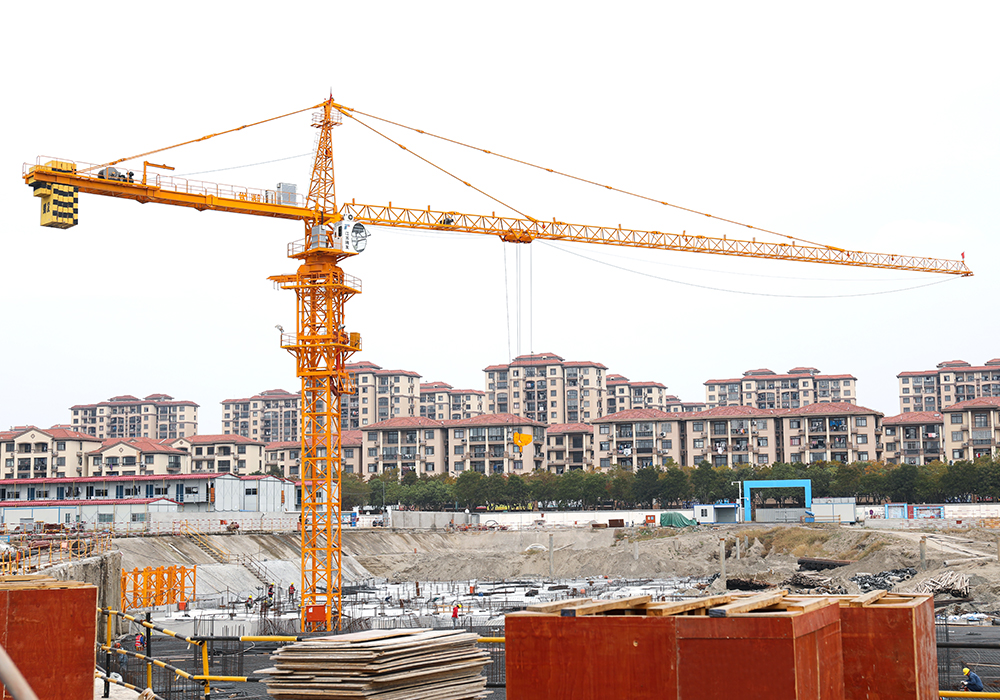
The QTZ100-6013 flat-top model illustrates these advantages in a compact package, with a 6 to 8 tonne maximum lifting capacity and jib length options from 36 to 60 m, covering typical mid-rise modular projects.
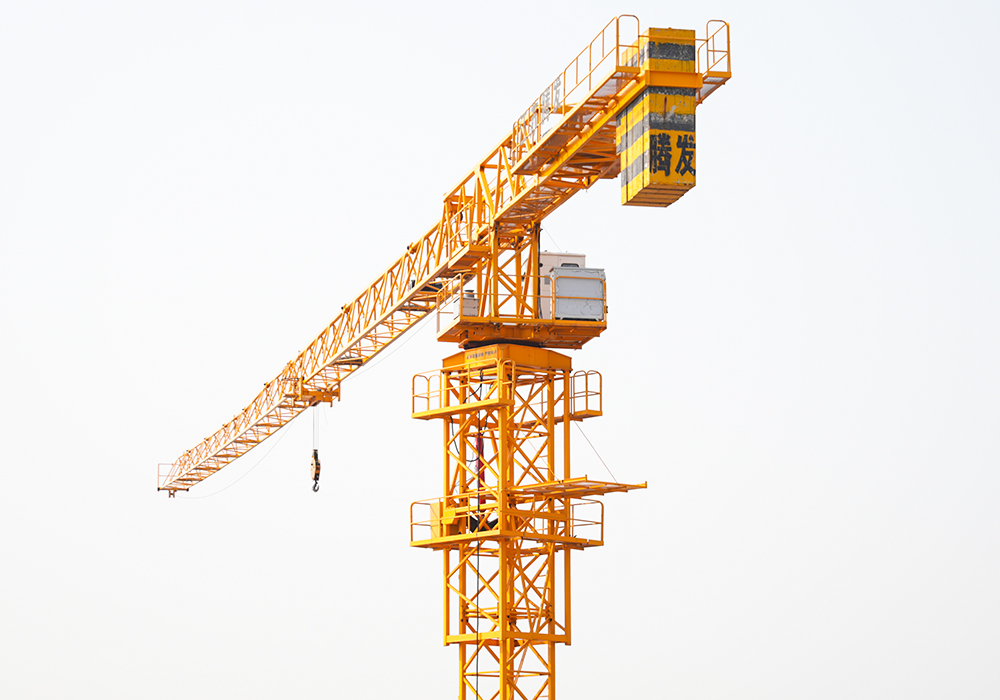 QTP100(6013) Flat-Top Tower Crane with 60m Jib and 6t CapacityThis flat-top model offers a 6 to 8 tonne capacity and jib options up to 60 m, suiting mid-rise modular builds. Its 40.5 m hook height and 140 m attached mode align with the article's focus on efficient setup and teardown cycles.View Product →
Faster Assembly, Dismantling, and Site-to-Site Mobility
One of the strongest arguments for flat-top cranes comes from their setup and teardown cycle. Modular construction projects are often shorter than conventional high-rise works, so the crane may be erected, used intensively for 6 to 18 months, then dismantled and moved to a new site.
Flat-top cranes assemble more quickly because there is no tower head section to lift into place, no tie bars or long counter-jib assembly, and the jib can be pinned directly to the mast top, reducing crane-assisted erection steps. Hydraulic self-erection and climbing systems are also simplified.
Contractors typically report that flat-top cranes cut erection time by 20 to 30 percent compared with hammerhead models of similar capacity. For a contractor operating across multiple modular projects, that difference translates directly into lower mobilization costs and more productive equipment utilization.
Precision and Control for Heavy Precast Elements
Precast panel erection is an exercise in controlled heavy lifting. Panels are usually lifted with a spreader beam, guided by tag lines, and set onto leveling bolts or guide sleeves. The crane must be responsive, stable, and precise at the moment of placement.
Flat-top cranes offer excellent rigidity because the jib connects directly to the tower without a flexible catenary of tie bars. The reduced sway and more direct load path give the operator a stable platform for final positioning. When combined with a variable-frequency drive hoist and smooth slewing control, a flat-top crane can place a 12-tonne wall panel with confidence.
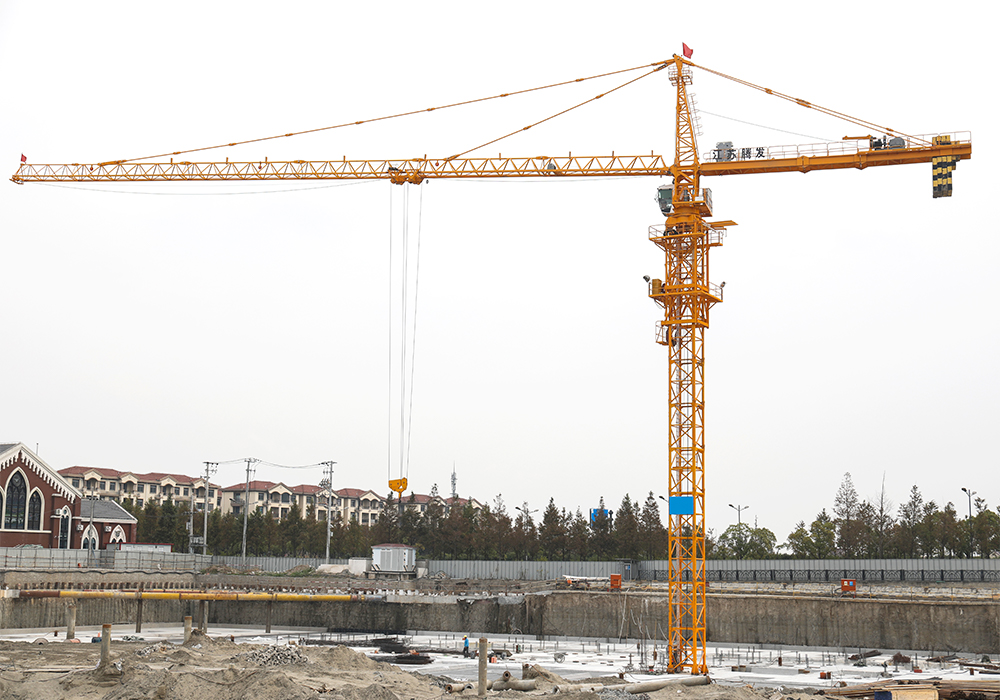
The QTP125-6016 flat-top crane, with an 8 tonne maximum load rating and a 60 m jib, is a practical example of the mid-capacity segment. Its wide lifting envelope allows a single crane to serve an entire modular housing block, minimizing the need for repositioning.
 QTP125(6016) Flat-Top Tower Crane with 8t Capacity and 60m JibWith an 8 tonne maximum load and a 60 m jib, this mid-capacity crane provides a wide lifting envelope for serving an entire modular block. Its 45 m independent height and 180 m attached reach make it suitable for tall prefabricated projects.View Product →
Safety, Visibility, and Multi-Crane Coordination
On any busy prefabricated jobsite, safety is paramount. Here the flat-top configuration offers several distinct advantages.
Operator visibility improves dramatically because the area directly above the cab is clear, with no tower head blocking the view of the hook and the load. When landing a precast panel on the far side of a 40-metre-high building, that viewing angle can be the difference between a smooth set and a costly repositioning.
For projects using multiple cranes, flat-top designs allow jibs to be positioned at different working heights and to lift over one another. The calculation of passing clearances is simpler and safer than with hammerhead or luffing rigs.
In addition, the double anti-loosening design used in flat-top tower crane bolts reduces the risk of bolted joint failure during high-frequency lifting cycles, a common concern when a crane is used intensively over a short period.
Cost Efficiency Across the Project Lifecycle
Looking at full project economics, flat-top cranes consistently perform well for modular and precast applications. The savings accumulate across every phase:
| Cost Factor | Flat-Top Crane | Hammerhead Crane |
|---|---|---|
| Transport | Fewer components | More pieces, larger head section |
| Erection labour | 2 to 3 days typical | 3 to 5 days typical |
| Maintenance | Less tie-bar inspection | Additional structural checks |
| Dismantling | Fast, low labour | Slower, more steps |
Lower transport volumes, shorter erection periods, reduced daily maintenance, and faster departure all lower the total cost of ownership.
Choosing the Right Flat-Top Crane for Your Project
Selecting the right flat-top crane for a precast-heavy project means examining several parameters:
- Maximum element weight and the radius at which it must be placed.
- Required tip load at the maximum jib length.
- Crane-to-crane crossing heights and climbing schedules.
- Design wind conditions and site orientation.
For heavier precast beams or large structural modules, the QTP200-6030 flat-top crane offers a 10 tonne capacity with a 60 m jib. Its robust mast and slewing system suit towers and podiums where the heaviest prefabricated assemblies are installed at height.
 QTP200(6030) Flat-Top Tower Crane with 10t Capacity and 60m JibDesigned for heavy precast beams and large modules, this crane lifts up to 10 tonnes at a 60 m radius. A rated moment of 2000 kN·m and 198 m attached height support installations of the heaviest prefabricated assemblies at height.View Product →
Jiangsu Tengfa Construction Machinery Co., Ltd., an A-level special equipment manufacturer, supports the entire flat-top series with spare parts such as standard sections, high-strength bolts, and safety devices, helping contractors keep their cranes in service across multiple modular projects.
FAQ
Q1: What is the main difference between flat-top and hammerhead tower cranes?
A flat-top crane has no tower head or tie bars; the jib is mounted directly on the mast top. A hammerhead crane uses a tower head with tie bars suspending the jib. The structural difference gives flat-top cranes simpler erection, better visibility, and easier multi-crane crossing.
Q2: Are flat-top tower cranes strong enough for heavy precast panels?
Yes. The QTP series ranges from 6 to 16 tonnes of lifting capacity depending on the model, enough to handle standard precast wall panels, floor slabs, and stair cores. Capacity must always be confirmed against the load chart at the required working radius.
Q3: Why are flat-top cranes more economical for modular construction?
Savings come from faster assembly and dismantling, fewer inspections, reduced transport costs, and the ability to quickly redeploy the crane across multiple short-duration projects. These factors lower the cost per tonne of installed precast element.
Conclusion
Modular and precast concrete construction demands a crane that is fast to set up, precise in its load path, and safe in multi-crane environments. Flat-top tower cranes satisfy these requirements through a structurally simple design that removes the tower head, shortens assembly times, and increases jobsite flexibility. As prefabrication continues to spread across the global building industry, the flat-top tower crane has become not just a practical choice, but the default technical answer.