

 English
 русский
 Español
 中文简体
中文简体
Content
- 1 The Direct Answer: When to Choose a Flat Head Over a Topkit Tower Crane
- 2 Understanding the Topkit Tower Crane
- 3 Understanding the Flat Head Tower Crane
- 4 Structural Load Path Comparison
- 5 Performance Data: Topkit Versus Flat Head Comparison
- 6 Assembly and Dismantling Efficiency on Site
- 7 Key Selection Factors and Decision Flow
- 8 The Bottom Line: Site Conditions Drive Crane Topology
The Direct Answer: When to Choose a Flat Head Over a Topkit Tower Crane
The decisive factor is job site congestion and overhead clearance. Choose a flat head tower crane whenever multiple cranes will overlap or a strict height ceiling exists. The absence of a towering A-frame and catenary cables allows the booms of several flat head cranes to pass over one another with minimal vertical separation, often saving 5 to 10 metres of mast section height per crane. Conversely, a topkit tower crane provides a significantly higher freestanding height for a given mast size and can more economically handle single-crane, heavy-lift duties above 16 tonnes.
In short, flat head cranes eliminate collision risk in fleet operations, while topkit cranes maximise lifting capacity per metre of tower. The selection thus begins with a site logistics plan, not a lift chart.
Understanding the Topkit Tower Crane
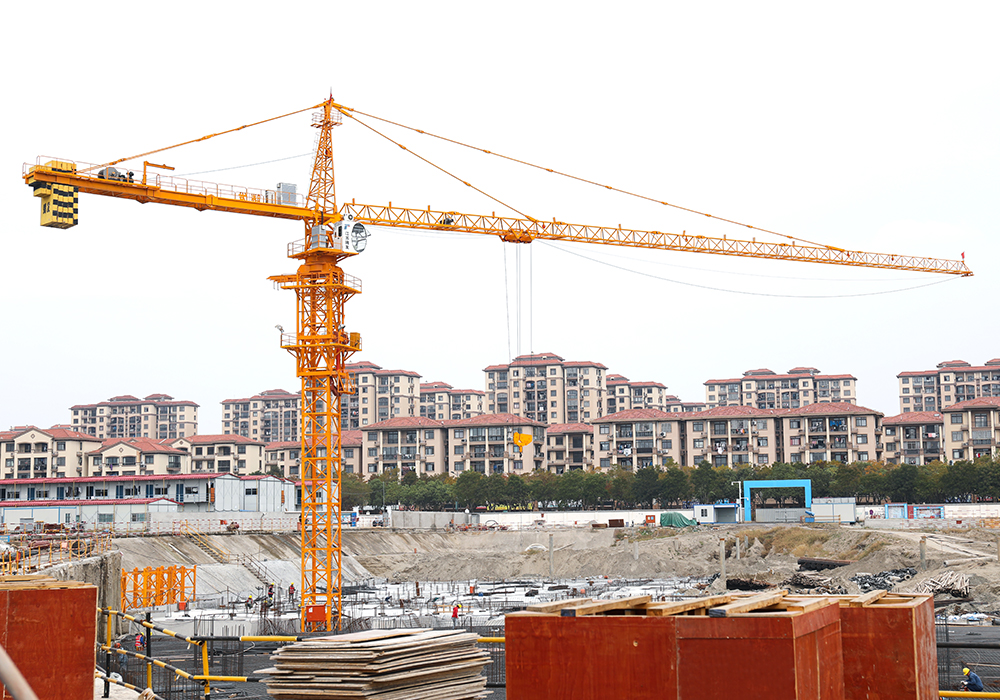
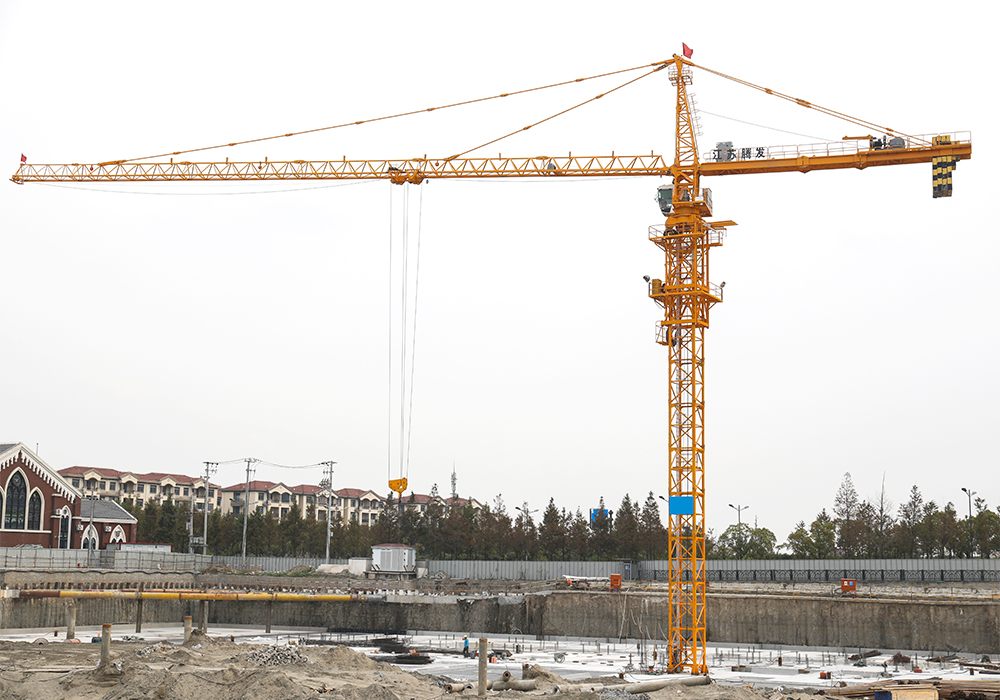
A topkit tower crane is defined by a prominent steel A-frame, or tower top, mounted above the slewing ring. From this peak, tensioned steel pendant lines radiate outward to support the jib and counter-jib. The jib is typically a truss structure with a central pivot for a luffing trolley, and the hoist rope runs from a winch on the counter-jib, up over the tower top, and down to the hook. This geometry creates a high-mount load path that efficiently resolves the jib’s bending moment into compression in the tower and tension in the rear pendants.
Common topkit models in the 8-to-12-tonne class achieve a freestanding hook height of up to 74 metres without any external tie-in. The tower top also acts as a stable mounting point for the hoist and trolley pulleys, making head assembly simpler during initial erection—provided the erecting assist crane has sufficient boom length to handle the peak height.
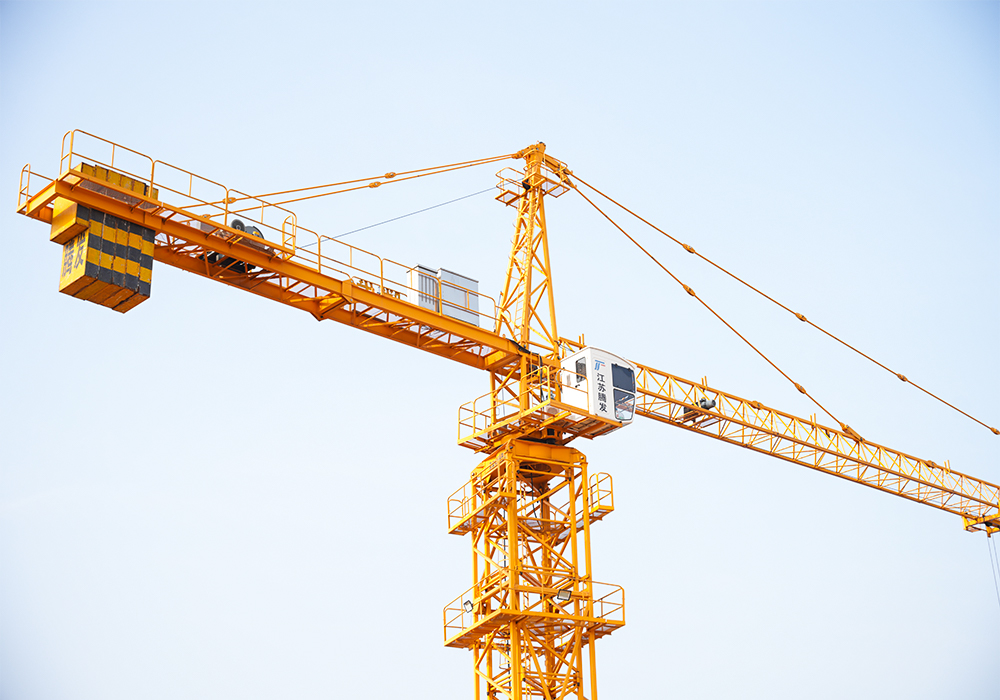
Understanding the Flat Head Tower Crane
A flat head tower crane eliminates the tower top and pendants entirely. The jib is built as a unified cantilevered truss extending from the slewing unit, with the hoist winch and trolley motor mounted directly on the jib itself. Both jib and counter-jib sections bolt directly to the slewing platform, forming a continuous horizontal beam. The load moment is carried entirely by the jib’s own chord and diagonal members, which must be stronger and heavier than those on an equivalent pendant-supported jib.
The operational advantage is dramatic when multiple cranes share airspace. The highest part of a flat head crane is its jib, and cranes can work with jib-to-jib vertical gaps as small as 3 metres, compared to the 10-metre gap typically required between a topkit crane’s tower top and another crane’s jib. This directly translates into fewer mast sections overall.
Structural Load Path Comparison
The key structural distinction lies in how each design resolves the jib moment. In a topkit crane, the tension pendants create a simply supported jib with a central fulcrum at the tower top, reducing maximum bending moment at the tower connection by approximately 40 to 55 percent compared to a pure cantilever of the same length. The tower mast itself is subjected mainly to axial compression plus a small overturning component. This allows lighter jib chords and a more slender mast for a given load rating.
A flat head crane functions as a full cantilever beam from the slewing ring outward. The jib root must resist the entire bending moment, requiring deeper truss sections and thicker chord steel, often resulting in a jib mass that is 8 to 12 percent heavier than a pendant-supported equivalent. This added weight is offset by the complete removal of the tower top assembly, pendants, and associated connectors, usually resulting in a net total upper structure weight within 5 percent between the two types.
Performance Data: Topkit Versus Flat Head Comparison
| Parameter | Topkit Tower Crane | Flat Head Tower Crane |
|---|---|---|
| Maximum lifting capacity | 10–16 t | 8–12 t |
| Jib tip load at maximum radius | 2.2–3.5 t | 1.8–3.0 t |
| Maximum freestanding height | 70–75 m | 55–65 m |
| Vertical clearance required over jib | 9–12 m (tower top above jib) | 0 m (jib is highest component) |
| Interference distance between cranes | 8–10 m min. jib-to-jib vertical gap | 3–5 m min. jib-to-jib vertical gap |
The topkit design retains a clear advantage in freestanding height and hook reach per mast section, which directly reduces the number of sections and base concrete required. The flat head design completely dominates the metric of overhead clearance, which is the primary constraint on urban infill sites.
Assembly and Dismantling Efficiency on Site
Topkit cranes require a capable assist crane to lift the tower top and pendant catenary lines into place. The pendants must be pinned and tensioned correctly, a process that typically adds three to five hours to the initial erection compared to a flat head. When dismantling, the assist crane must reach the elevated tower top again, often requiring a larger crawler crane for tall installations.
Flat head cranes assemble section-by-section from the ground up with a simplified sequence. Each jib section is lifted and bolted directly to the previous section without any temporary guying. Dismantling follows the exact reverse, allowing a smaller assist crane to pick the tip sections first while the base jib remains stable. In urban projects with just one assist crane position possible, this self-supporting disassembly reduces the required assist crane capacity by up to 30 percent.
Key Selection Factors and Decision Flow
- Multiple cranes on one site: Flat head is the default choice to prevent tower top collisions.
- Height restriction due to aviation or zoning: Flat head avoids the extra height of a tower top.
- Single crane, heavy lifts above 12 tonnes: Topkit provides better structural efficiency and lower jib weight per tonne lifted.
- Long freestanding mast without ties: Topkit achieves 70 metres or more without building attachment, reducing the need for complex tie engineering.
- Rapid intra-urban deployment with small assist crane: Flat head simplifies both erection and dismantling logistics.
The Bottom Line: Site Conditions Drive Crane Topology
Neither design is universally superior. The selection must be resolved by plotting the jib intersection diagram on the site plan and checking the assist crane access routes. If any jib‑to‑jib or jib‑to‑building clearance falls below 5 metres, a flat head is mandatory. If the lift plan shows repeated picks beyond 10 tonnes at a 60-metre radius and the crane works alone, the structural economy of a topkit crane will lower the total cost per tonne. In every case, the decision should be validated with a full clash analysis and a detailed erection logistics plan that accounts for the reach and capacity of the available assist crane fleet.