

 English
 русский
 Español
 中文简体
中文简体
Content
What Is a Luffing Jib Tower Crane?
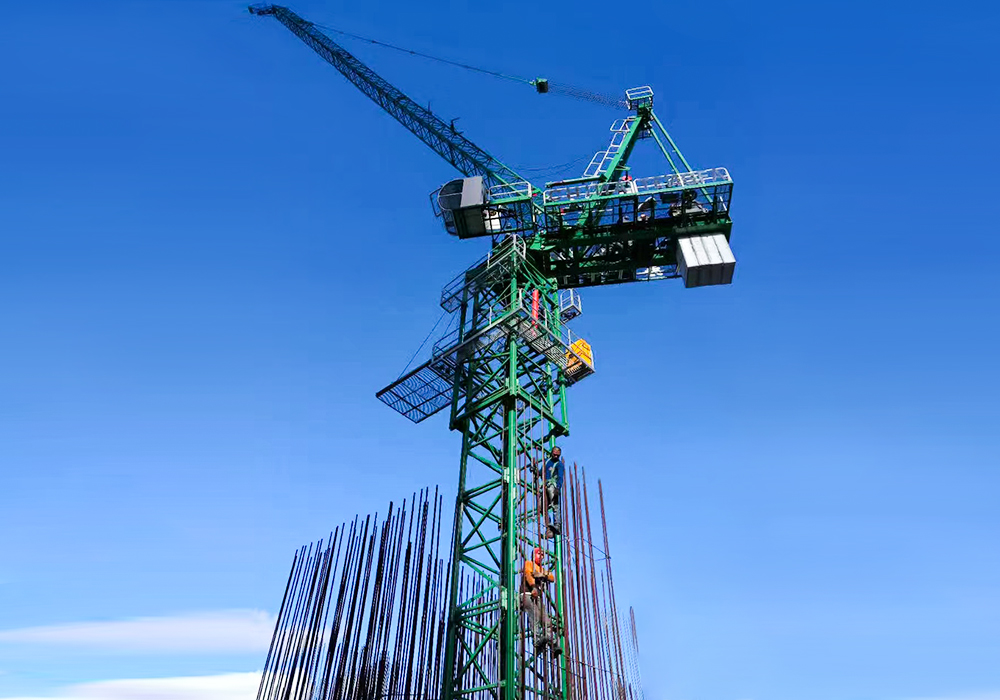
A luffing jib tower crane is a type of tower crane in which the jib — the horizontal boom that carries the load — is hinged at its base and can be raised or lowered in a vertical arc through a luffing mechanism, rather than remaining fixed at a horizontal angle as on a conventional flat-top or hammerhead crane. This variable jib angle is the defining structural and operational characteristic of the luffing jib configuration, and it directly determines where and why the crane type is specified on construction projects.
When the jib is raised to a steep angle — typically between 15° and 75° from horizontal depending on the model and load — the crane's working radius decreases significantly. When the jib is lowered toward horizontal, the working radius extends to its maximum. Luffing the jib to change radius under load is performed by a dedicated luffing winch, separate from the hoisting and slewing drives. The result is a crane that can work within a compact overhead footprint, sweeping loads in a tight arc without the jib tip extending far beyond the structure being built.
Luffing jib cranes are manufactured in a wide capacity range. Urban construction models typically offer maximum rated capacities of 8 to 32 tonnes at minimum radius, with maximum jib lengths from 30 m to 80 m. Heavy industrial variants used in shipbuilding, offshore construction, and power station erection can reach rated capacities exceeding 100 tonnes at minimum radius, with correspondingly larger mast sections and foundation requirements.
Why Luffing Jib Cranes Are Specified: Site Constraints and Airspace Management
The fundamental reason a luffing jib crane is selected over a flat-top or hammerhead crane is airspace constraint. On urban construction sites surrounded by existing buildings, adjacent live infrastructure, or restricted airspace — airports, helipads, protected heritage structures — a flat-top crane's fixed horizontal jib would extend over neighboring properties or controlled airspace during slewing, creating planning permission obstacles, liability exposure, and in some jurisdictions an absolute regulatory prohibition.
By raising the jib to a steep angle, a luffing crane can slew through 360° with a dramatically reduced overhead sweep radius. In dense urban environments where multiple tower cranes are operating on the same site or on adjacent sites simultaneously, luffing jib cranes enable anti-collision crane groupings that would be impossible with fixed-jib machines. A cluster of luffing cranes operating at different heights and jib angles can share overlapping airspace safely, with each crane's reduced swept volume creating separation margins that flat-top jibs cannot achieve.
Multi-Crane Site Planning
On high-density residential and mixed-use developments — the construction typology that drives the highest luffing jib demand globally — it is common for four to twelve luffing cranes to operate simultaneously on a single site footprint. Each crane is positioned at a different height, with jib angles and radii programmed into anti-collision systems that automatically limit slewing and luffing movements when two cranes approach a defined separation envelope. The flexibility of the luffing jib — able to retract its radius on command — is what makes these dense crane groupings manageable from both a safety and a program efficiency standpoint.
Proximity to Existing Structures
Basement excavation and podium construction phases frequently require cranes to operate immediately adjacent to party walls, underground services, or structures in continued occupation. A luffing jib crane positioned close to a site boundary can raise its jib steeply when slewing toward the boundary and lower it when working over the open excavation, keeping the jib tip within the site boundary throughout its operating cycle. This boundary-respecting capability is often the deciding factor in obtaining planning consent for crane installation in city-center projects where neighboring property owners' rights to unobstructed airspace are legally enforceable.
Technical Characteristics and Load Chart Principles
The operating parameters of a luffing jib tower crane are governed by its load chart, which defines the maximum permitted load as a function of working radius. Unlike a flat-top crane with a simple single load-radius curve, the luffing crane's load chart reflects the interaction between jib angle, working radius, and load capacity — a more complex relationship driven by the structural geometry of the inclined jib.
Load-Radius Relationship
As the jib is luffed upward and working radius decreases, the crane's permitted load capacity increases — because the moment arm (horizontal distance from mast centerline to load) is reduced, allowing a heavier load to be lifted within the crane's structural and stability limits. At maximum radius (jib near horizontal), permitted load is at its minimum. At minimum radius (jib steeply inclined), permitted load reaches its maximum rated value. A typical mid-size luffing jib crane might carry 16 tonnes at 15 m radius and 3.2 tonnes at 55 m radius — a five-fold variation across its working range.
Mast Height and Free-Standing vs. Tied Configurations
Luffing jib tower cranes are erected either as free-standing structures (supported only by their foundation) or in tied configurations where the mast is anchored to the building structure at one or more levels as the building rises. Free-standing height is limited by the crane's structural calculations — typically 40 m to 60 m of free-standing mast for most urban models — while tied configurations allow the crane to climb with the building, reaching heights of 200 m or more on supertall projects by adding mast sections below the slewing ring in a jump-climbing sequence.
Jib Configurations
Luffing jibs are available in lattice steel truss construction (the industry standard for large cranes) and, on smaller urban models, as solid or semi-lattice profiles designed for compact transport and rapid assembly. Jib length is typically field-adjustable through the addition or removal of intermediate sections, allowing the same crane model to be configured at different maximum radii depending on site requirements and the applicable load chart for each configuration.
| Parameter | Typical Urban Model | Heavy Industrial Model |
|---|---|---|
| Max rated capacity (min radius) | 8–32 t | 50–160 t |
| Maximum jib length | 30–65 m | 60–100 m |
| Jib angle range | 15°–85° | 10°–80° |
| Free-standing height | 40–60 m | 30–55 m |
| Slewing speed | 0.6–0.8 rpm | 0.3–0.6 rpm |
| Hoist line speed (max) | 80–120 m/min | 40–90 m/min |
| Primary application | Urban high-rise, mixed-use development | Shipbuilding, offshore, power generation |
Luffing Jib vs. Flat-Top and Hammerhead Tower Cranes
Selecting between a luffing jib, flat-top, and hammerhead configuration involves balancing site-specific constraints against operational efficiency and cost. Each type has a distinct performance profile, and understanding the trade-offs is essential for crane selection on complex projects.
Operational Efficiency
Flat-top and hammerhead cranes with horizontal trolley travel offer faster and more intuitive load placement than luffing cranes, because the hoist path is vertical and radius change involves only horizontal trolley movement rather than the combined luffing and hoisting motion required on a luffing crane. Experienced operators on luffing cranes can achieve comparable cycle times, but the learning curve is steeper and the cognitive load on the operator is higher — a factor in projects where crane operators are rotated frequently or where long-distance remote operation is used.
Assembly and Dismantling
Luffing jib cranes are generally more complex to assemble and dismantle than flat-top cranes of equivalent capacity, due to the additional luffing mechanism, backstay ropes, and jib pivot hardware. Assembly on confined urban sites — where the crane must often be erected using a mobile crane operating within the same restricted space — requires careful sequence planning. Dismantling at project completion, when surrounding structures may have further constrained the available mobile crane working area, is frequently the most logistically challenging phase of the luffing crane's site life.
Cost Considerations
Luffing jib cranes carry a purchase price and rental rate premium of 20–40% over flat-top cranes of comparable capacity, reflecting their greater mechanical complexity and the specialized market they serve. Foundation loads are also typically higher for luffing cranes due to the dynamic forces introduced by luffing motion, which can increase foundation design costs on constrained urban sites with limited substructure options. These cost premiums are routinely accepted by project teams when the alternative is a planning restriction that prevents the project from proceeding at all — underscoring that the luffing jib crane's value proposition is not primarily economic efficiency but site feasibility.