

 English
 русский
 Español
 中文简体

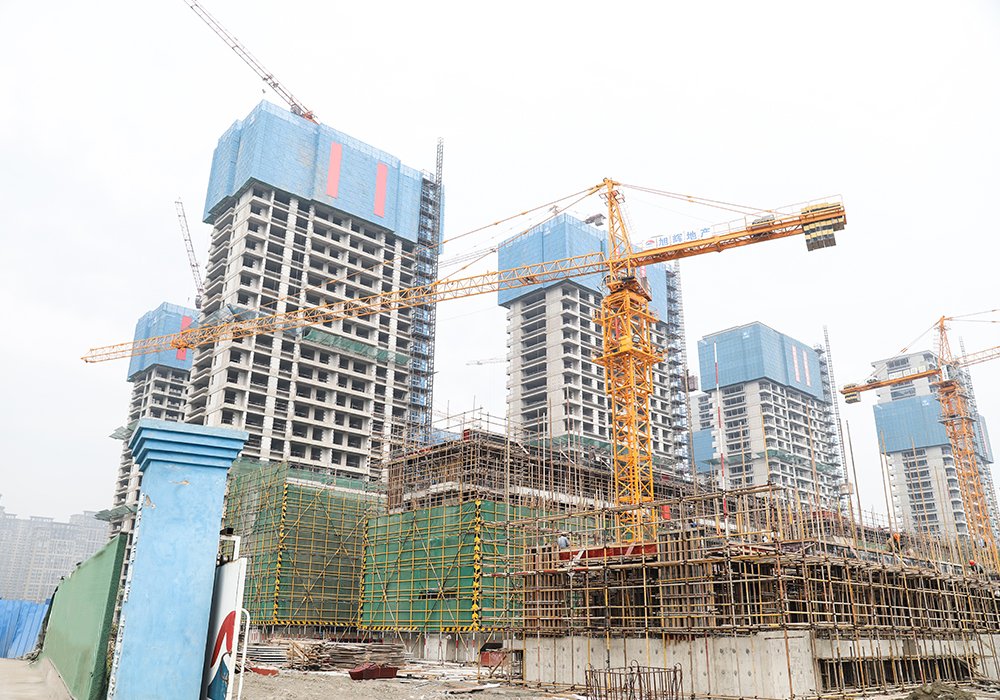
High-density city centers present a challenge that tower crane planners rarely face on open land: the airspace around a construction site is already occupied. Between neighboring towers, busy pedestrian streets, heritage facades, and temporary site infrastructure, there is often no room for a crane jib to sweep a full 360 degrees. In this environment, oversailing, the moment a crane boom swings over property beyond the site boundary, is both a legal and a safety risk. The luffing jib crane has become the standard answer to this problem because its hinged boom can be raised and lowered, giving operators a direct mechanical tool to reduce the crane horizontal footprint on demand.
Content
- 1 What Is Oversailing and Why City Centers Prohibit It
- 2 How Raising the Boom Eliminates the Oversailing Hazard
- 3 Beyond Geometry: Safety Systems That Keep the Boom in Bounds
- 4 Luffing, Flat-Top, and Hammerhead Cranes: A Dense-Site Comparison
- 5 Matching the Luffing Jib Crane to the City Project
- 6 Frequently Asked Questions
- 7 A Crane That Respects the City Limits
What Is Oversailing and Why City Centers Prohibit It
Oversailing occurs when any part of a tower crane, usually the jib, the counter-jib, or the suspended load, passes over land, buildings, or public spaces outside the construction site boundary. In dense urban districts, property lines sit close together and air rights are often leased or regulated, so even a brief sweep over a neighboring roof can breach an agreement or a municipal bylaw.
The risks are not only legal. Falling objects, suspended loads, and moving crane parts above occupied buildings create a serious public safety exposure. A dropped concrete bucket, a slipping hook block, or a detached pendant line can damage property and injure people who have no connection to the construction work. For this reason, many city planning departments require cranes to stay strictly within the site airspace, and some sites are simply unbuildable with a crane that cannot pull its jib out of a neighboring property airspace.
How Raising the Boom Eliminates the Oversailing Hazard
The core mechanism is straightforward. A conventional trolley jib crane, whether hammerhead or flat-top, keeps its jib horizontal and moves the load along the jib with a trolley. When the crane is idle, the full jib length still sticks out horizontally and sweeps a large radius as the crane slews. A luffing jib crane, by contrast, has its jib hinged at the tower top. The operator can change the boom angle continuously, from near horizontal to well past 60 degrees.
Raising the boom has a direct geometric effect. For a 40-meter jib positioned at 70 degrees above horizontal, the horizontal projection is only about 13.7 meters; at 75 degrees it falls to roughly 10.4 meters. The crane swept radius shrinks dramatically, often allowing the machine to keep its hook, load block, and jib tip inside the site boundary even while the tower stands close to the property line. This principle is central to safe dense-city operations. For a more detailed look at how these machines avoid collisions when multiple cranes share a congested skyline, see our analysis of how the luffing jib tower crane avoids collision risks in construction.
Luffing Angle, Headroom, and the Trade-Off Site Planners Must Accept
The reduction in radius does not come free. When the boom is angled upward, the load point moves higher as well as closer to the mast. The crane must therefore have enough hook height below the boom tip to place loads at the required floor level. Luffing operations also create additional dynamic forces on the mast and the slewing assembly. On rope-operated luffing cranes, raising the boom beyond roughly 70 degrees requires careful attention to the load chart, because the geometry of the pendant ropes and the boom own weight begin to change the stability balance. These factors are manageable, but they have to be planned before the crane is selected.
Beyond Geometry: Safety Systems That Keep the Boom in Bounds
A steep luffing angle is the primary defense against oversailing, but it is not the only one. Modern tower cranes, and especially luffing jib units destined for city sites, integrate multiple systems that prevent the crane from being moved into an unsafe position:
- Load moment limiters continuously compare the actual load against the permitted load for the current radius and cut power to the drives if a lift would exceed the safe working envelope.
- Anti-collision and zone-limiting systems allow the site team to program no-fly zones in the slewing path, so the crane physically stops or slows before the jib crosses a protected boundary.
- Wind speed monitors alert operators when gusts approach the maximum permitted working wind speed, prompting them to luff the boom up and reduce wind exposure.
- Luffing limit switches lock the boom at preset upper and lower angle limits, preventing the operator from accidentally driving the jib through a dangerous position.
On dense urban sites, these systems matter as much as the mechanical luffing action itself. A well-configured luffing crane can be programmed to keep its jib inside the site for every lift, even when the operator works near the edge of the envelope. Site teams that combine these features with a strict lifting protocol consistently reduce both oversailing incidents and the delays caused by last-minute coordination with neighbors. A broader view of this approach is available in our review of the luffing jib tower crane as an urban construction tool.
Luffing, Flat-Top, and Hammerhead Cranes: A Dense-Site Comparison
To see where the luffing jib crane fits, it helps to compare the three common tower crane configurations side by side.
| Configuration | Jib motion | Oversailing footprint | Best fit | Main constraint |
|---|---|---|---|---|
| Luffing jib | Boom raises and lowers | Small when luffed up | Tight infill sites, high-rise cores, group crane jobs | Higher cost, extra hook height needed |
| Flat-top | Trolley on horizontal jib | Full jib radius always | Rapid erection, multiple cranes on one site | Requires clearance equal to jib length |
| Hammerhead topkit | Trolley on tied horizontal jib | Full jib radius always | High capacity and long reach | Large swing radius, may oversail neighbors |
The comparison makes the choice clear. If the site has generous clearance, a flat-top or hammerhead crane can deliver high capacity at a lower purchase price. If the site is surrounded by occupied buildings and narrow streets, the luffing jib crane is usually the only configuration that can guarantee the jib will stay within the boundary without severe load restrictions.
Matching the Luffing Jib Crane to the City Project
Once the configuration is settled, the next task is choosing the right size. The three numbers that dominate selection are maximum load, jib length, and load at maximum radius. A high-rise residential tower might need only 4 to 6 tonnes at the far end of the jib for precast panels and rebar bundles; a commercial core with heavy steel columns could push that demand to 8 or 10 tonnes.
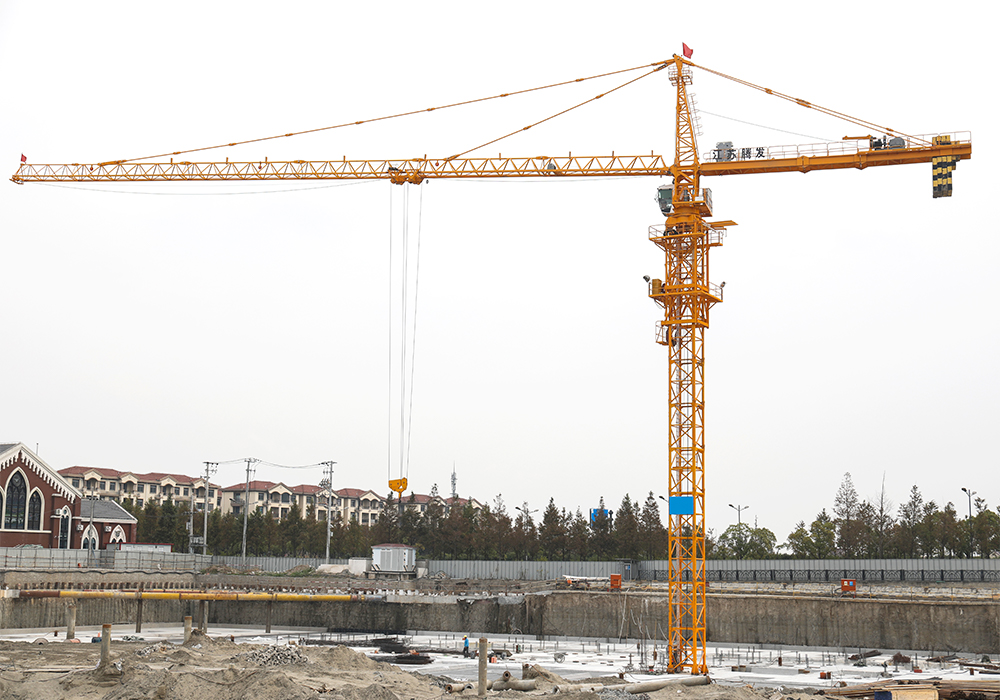
Manufacturers serving the urban segment have developed dedicated luffing jib lines to cover exactly these load bands. Jiangsu Tengfa Construction Machinery, for example, builds its QTD series with capacities from 6 to 10 tonnes and jib lengths from 40 to 50 meters, sized for typical city-center infill and mid- to high-rise projects. These purpose-built luffers show how the configuration can be tuned for real-world urban constraints:
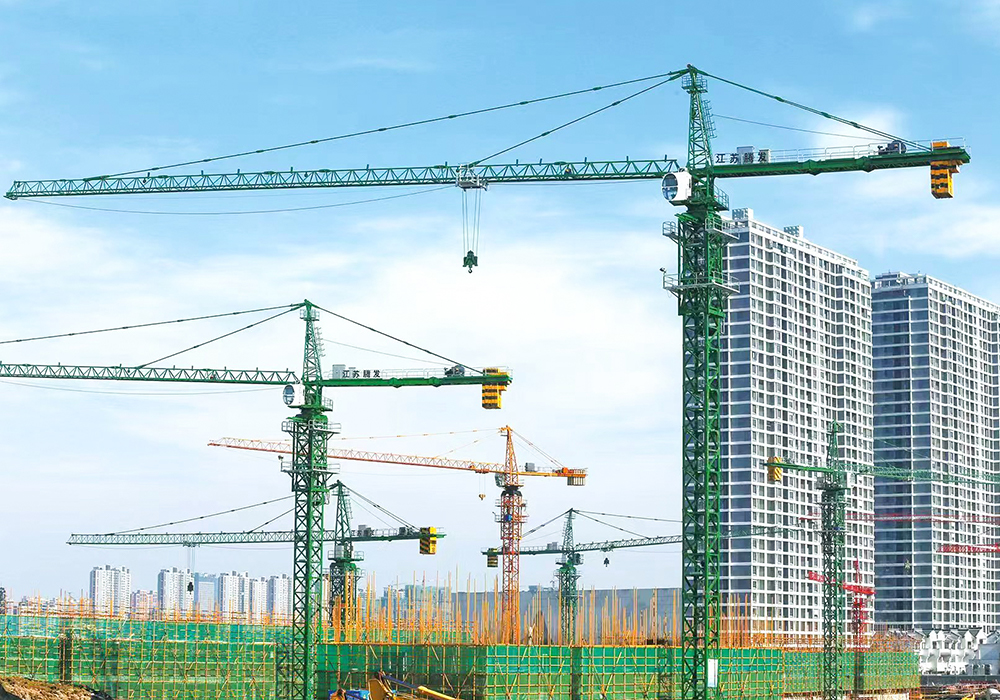 QTD80 Luffing-Jib Tower Crane with 40m Radius and 6t CapacityThis 6-ton luffing-jib crane reaches 40 meters and offers a rated moment of 800 kN·m, suiting mid-rise urban infill projects where compact jib parking and precise load control matter.View Product →
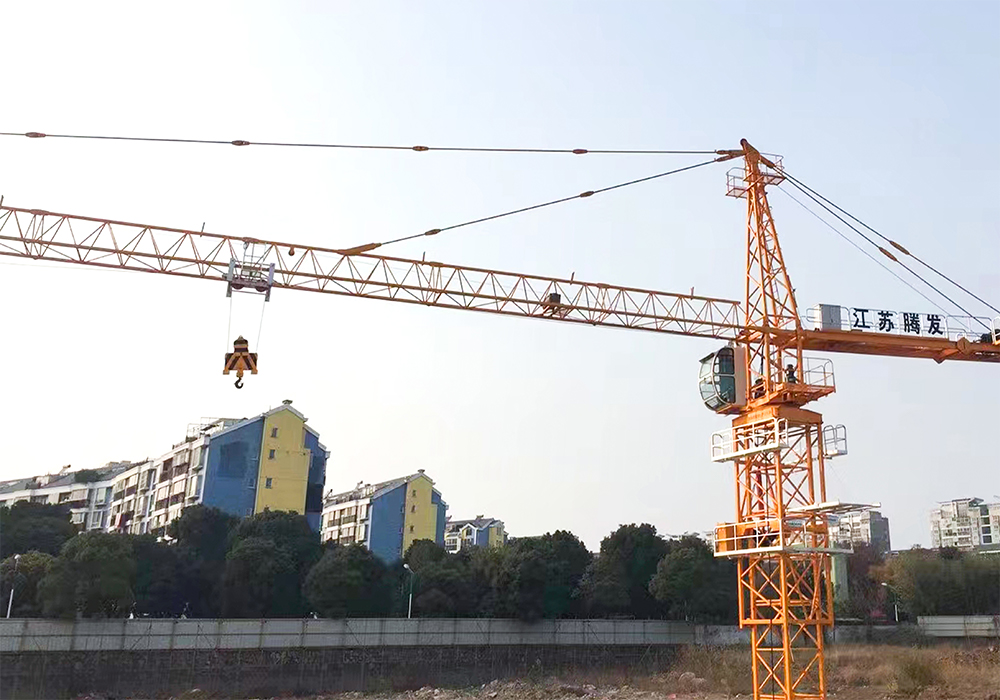 QTD125 Luffing-Jib Tower Crane with 45m Radius and 8t CapacityWith an 8-ton lift capacity and 45-meter radius, this model provides a 1250 kN·m rated moment, ideal for higher urban buildings needing greater reach and flexibility.View Product →
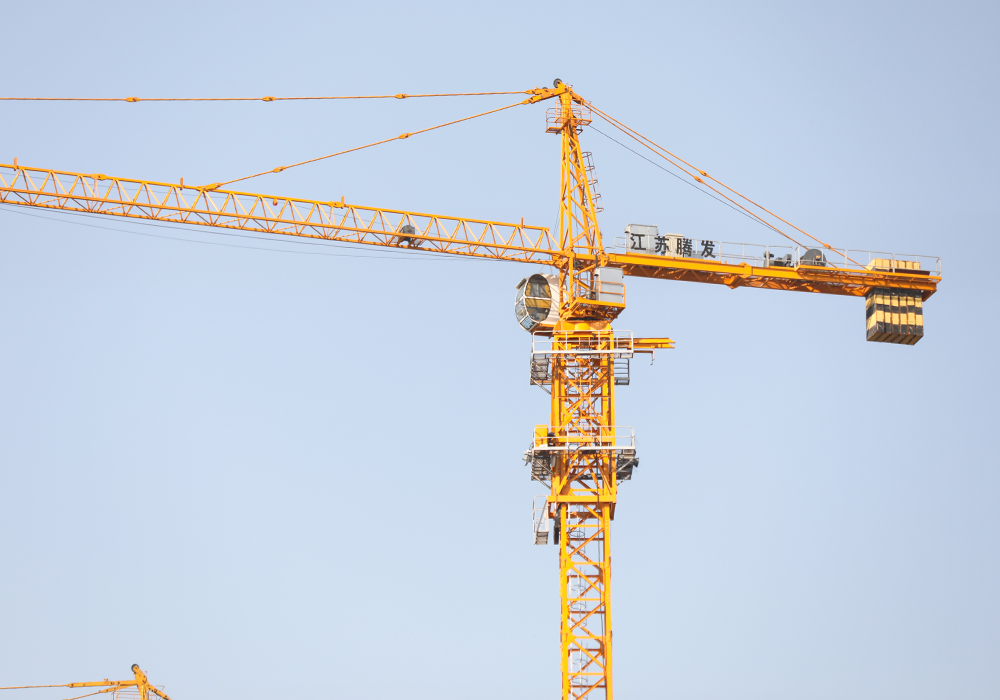 QTD160 Luffing-Jib Crane with 50m Radius and 10t CapacityThis 10-ton luffing-jib crane extends to 50 meters with a 1600 kN·m rated moment, giving tall urban projects the reach and payload needed for heavy prefabricated elements.View Product →
When evaluating any of these machines, site planners should check four things: the minimum radius at which the jib can be parked for free slewing, the hook height available when the boom is luffed to the working angle, the load moment limiter settings, and whether the crane erection plan fits the available laydown area. Getting these parameters right is what separates a smooth urban lift sequence from a project that stalls at every coordination meeting.
Frequently Asked Questions
Q1: What is oversailing in tower crane operations?
Oversailing is the situation in which a crane jib, counter-jib, or suspended load passes over land or structures beyond the construction site legal boundary. It matters in city centers because it creates legal liability and public safety risks.
Q2: Can a luffing jib crane completely eliminate oversailing?
In most practical cases, yes. When the boom is raised to a steep angle, the horizontal projection of the jib can be reduced to less than a third of its full length. The remaining sweep can often be kept entirely inside the site boundary. The exact result depends on the tower position, jib length, and the angle allowed by the crane load chart.
Q3: What luffing angle should be used on a dense urban site?
Most operators work between 60 and 75 degrees for the lifts they perform and luff up to the maximum parked angle when the crane is idle. Above roughly 70 degrees on rope-operated luffers, the load chart becomes more restrictive, so the planned lift weights and the angle must be verified together.
Q4: Are luffing jib cranes more expensive than flat-top cranes?
The purchase and rental cost of a luffing jib crane is typically higher, and the mast and hoist may need additional capacity to handle the vertical component of the luffing action. However, on a constrained city site, the alternative is often a smaller crane, longer logistics chains, or an unbuildable footprint, costs that quickly exceed the premium for a luffer.
A Crane That Respects the City Limits
Oversailing is not a problem that can be solved with better site signage or more coordination meetings. It is a geometric problem, and the luffing jib crane is a geometric answer. By giving operators control over the boom angle, it lets a tower crane shrink its reach whenever the slewing path approaches a boundary, then extend again when the next lift demands more radius. For high-density city centers, that flexibility is not a convenience. It is the reason many of these buildings get built at all.